


Anthropic is attracting growing attention as the artificial intelligence company prepares for its next phase of growth, with investor interest increasingly focused on its revenue potential, long-term business strategy and approach to AI safety.
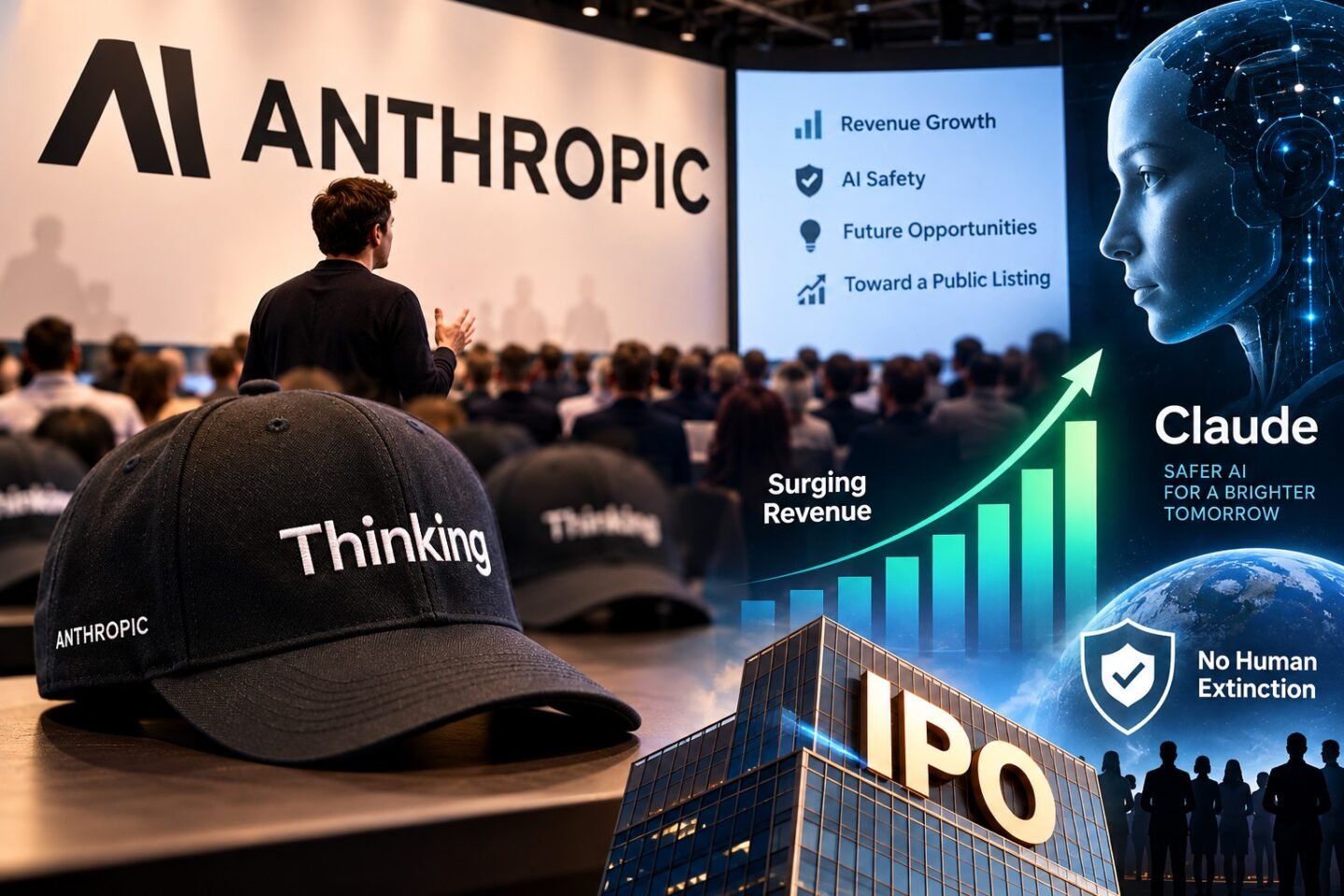
At a reported pre-IPO gathering, the company’s culture and commercial ambitions were reflected in an unusual combination of branded “Thinking” caps, discussions around surging revenue and reassurances about the risks associated with increasingly powerful AI systems. The gathering highlights a central question facing the AI industry: Can companies build highly profitable AI businesses while maintaining strong safeguards against potentially dangerous outcomes?
Anthropic’s Growing Business Ambitions
Founded by former OpenAI employees, Anthropic has established itself as a major player in generative AI through its Claude family of models. The company has positioned Claude around capabilities such as coding, reasoning, enterprise productivity and complex problem-solving.
Its business model includes paid subscriptions, enterprise offerings and API access that allows developers to integrate Claude into their own products and workflows.
As demand for AI tools increases, enterprise adoption has become an important growth opportunity. Businesses are using AI to automate repetitive tasks, assist software development, analyze information and improve internal operations.
For Anthropic, expanding commercial adoption could strengthen recurring revenue and improve its position in an increasingly competitive market.
However, sustained growth will depend on more than user demand. Computing costs, infrastructure investments, competition and the economics of serving increasingly capable models will all influence long-term profitability.
What the ‘Thinking’ Caps Represent
The reported “Thinking” caps offer a glimpse into the company’s identity and the culture surrounding its AI research.
The idea of thinking is closely associated with the current generation of AI models, which are increasingly designed to tackle complex tasks through extended reasoning, planning and multi-step problem-solving.
These capabilities are particularly relevant to coding, research, data analysis and enterprise workflows, where users often need more than a simple question-and-answer response.
Yet, the ability of an AI system to produce convincing reasoning does not automatically mean it understands the world in the same way humans do. Model performance must be evaluated through real-world testing, reliability measurements and careful assessment of failure modes.
The contrast between a lighthearted piece of company merchandise and the serious technical work behind AI development reflects the broader culture of an industry attempting to turn advanced research into commercially valuable products.
Revenue Growth Puts Anthropic in the Spotlight
Revenue growth has become one of the most closely watched indicators of progress among leading AI companies.
Anthropic benefits from several potential sources of commercial demand, including businesses adopting Claude for software development, customer support, document analysis and internal automation.
The opportunity extends beyond individual subscriptions. Enterprise contracts and API usage can create substantial recurring business when customers integrate AI tools into essential workflows.
Nevertheless, investors need to distinguish between reported revenue, annualized revenue run rates, future projections and actual profitability. These figures measure different things and should not be treated as interchangeable.
AI development also requires substantial spending on computing infrastructure, talent, research and safety evaluation. Strong sales do not necessarily translate into positive cash flow or sustainable profits.
For any potential public offering, investors will likely examine revenue quality, customer retention, margins, infrastructure commitments and the company’s ability to maintain its growth as competition intensifies.
AI Safety Remains a Central Question
Anthropic has made AI safety a prominent part of its public identity. Its research and development approach includes work on model evaluations, alignment, interpretability and safeguards intended to reduce harmful behavior.
The reported reassurance around human extinction reflects a broader debate about the long-term risks posed by increasingly capable AI systems.
Some researchers warn that advanced systems could create serious risks if they develop dangerous capabilities, are misused or operate beyond effective human oversight. Others emphasize nearer-term concerns, including misinformation, cybersecurity threats, bias and failures in high-stakes applications.
There is no established basis for treating catastrophic AI outcomes as inevitable, but neither can long-term risks be dismissed simply because a company has safety policies in place.
Effective safety requires measurable evidence, independent scrutiny, continuous testing and clear accountability. Investors and customers should assess both a company’s stated commitments and the effectiveness of its safeguards in practice.
The Challenge of Balancing Growth and Responsibility
Anthropic faces a challenge shared by the broader AI industry: developing increasingly capable systems while controlling costs, meeting customer expectations and managing risks.
Moving quickly can help a company capture market share, but deploying powerful systems without sufficient evaluation can create technical, reputational and regulatory problems.
At the same time, excessive caution can affect product competitiveness and delay commercial opportunities.
The long-term advantage may belong to companies that can combine reliable AI products, efficient infrastructure, strong enterprise relationships and credible safety practices.
For Anthropic, these factors could become particularly important as it evaluates its future financing options and the possibility of entering public markets.
What a Potential Anthropic IPO Could Mean for the AI Industry
A potential Anthropic IPO would attract attention beyond the company itself. It could provide investors with a new way to evaluate the economics of a leading AI developer and compare its growth, costs and business model with those of other technology companies.
A public listing would also bring greater scrutiny of financial performance, governance, risk disclosures and long-term capital requirements.
However, a pre-IPO meeting does not by itself confirm an IPO date, valuation or final listing plan. Those details require official confirmation.
Investors should therefore separate the excitement surrounding AI growth from verified financial information and formal corporate announcements.
The Bigger Picture
Anthropic’s reported pre-IPO gathering captures three themes shaping the AI sector: commercial momentum, an evolving culture of AI-powered reasoning and continuing questions about safety.
The company’s future success will depend on whether it can translate demand for Claude into durable business growth while demonstrating that its systems can be developed and deployed responsibly.
As the AI industry moves toward its next stage, revenue may attract investors initially, but sustainable economics, product performance and credible risk management are likely to matter just as much over the long term.