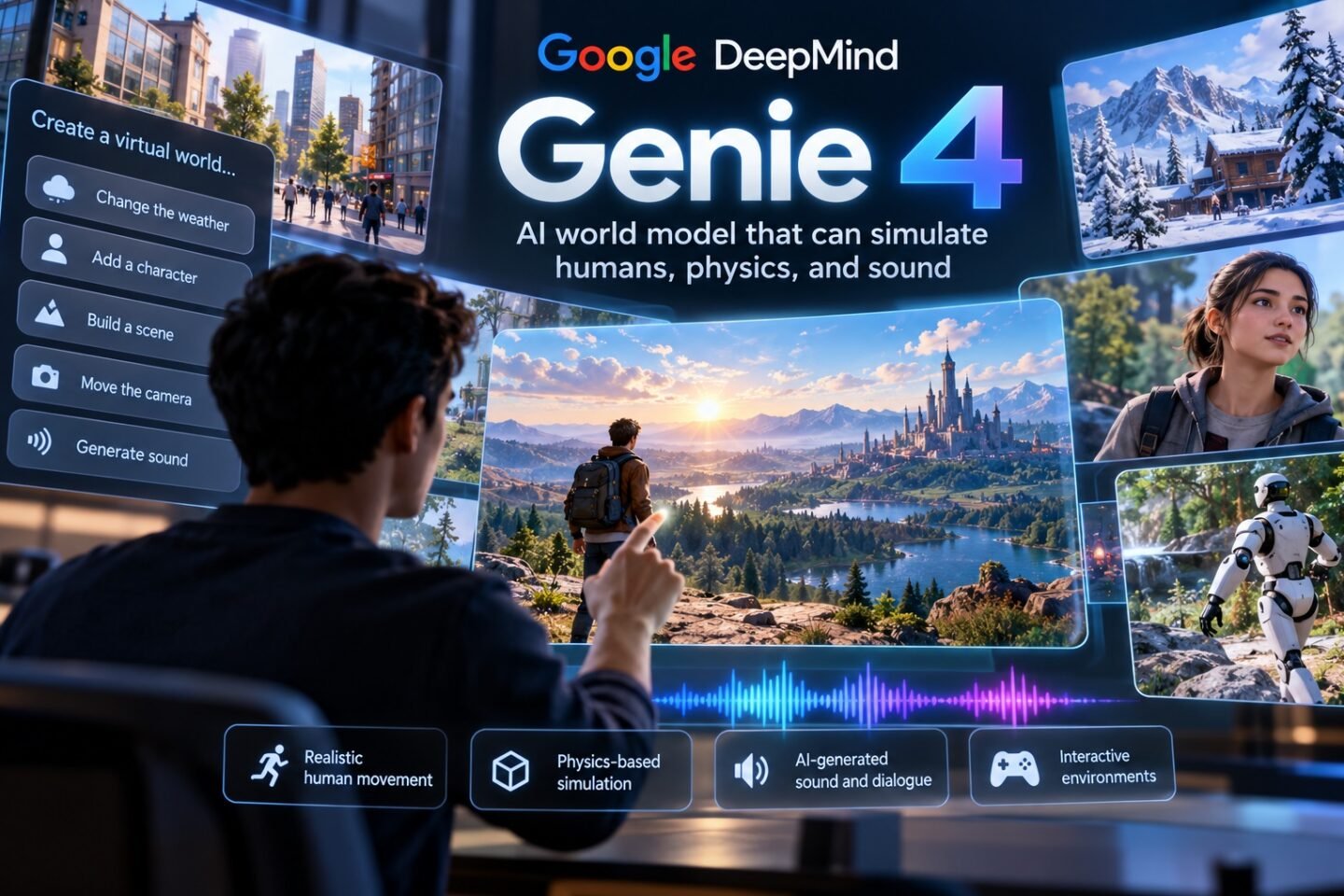



Google DeepMind has introduced Genie 4, a new artificial intelligence world model designed to create realistic, interactive virtual environments that users can explore and modify in real time. The technology represents a significant development in AI-generated worlds, combining visual simulation, human-like movement, physical interactions and sound within a single experience.
Genie 4 builds on Google’s earlier world-model research and incorporates capabilities from the Gemini family of AI models. Unlike conventional video-generation systems that primarily produce clips for viewing, Genie 4 aims to create environments that respond to user actions and continue evolving as the simulation progresses.
The announcement highlights the growing role of AI in gaming, filmmaking, robotics, education and other fields where realistic, adaptable simulations could help people test ideas and explore scenarios before implementing them in the real world.
What Is Google Genie 4?
Genie 4 is an AI world model developed by Google DeepMind. A world model is an AI system designed to represent how an environment behaves and predict what might happen when objects, people or other elements interact.
For example, a user could explore a virtual landscape, introduce a new character, change the weather or move the camera to a different position. Genie 4 attempts to generate the resulting changes while maintaining the continuity of the surrounding environment.
This approach goes beyond generating a static image or predetermined video. The objective is to create an interactive experience in which users can influence what happens next.
Google says Genie 4 combines the world-generation capabilities of Genie with reasoning and contextual understanding from Gemini models. Gemini Omni helps ground the simulations in realistic appearances and behaviour, while other Gemini capabilities help maintain coherence as events unfold.
Key Features of Genie 4
1. Real-Time Interactive World Generation
One of Genie 4’s most notable features is its ability to generate and modify virtual environments while users interact with them.
Users can issue natural-language instructions to change elements of an ongoing simulation. For example, they could request a change in weather, introduce a new person or object, or adjust the camera angle.
Instead of rebuilding the entire scene from the beginning, the system attempts to incorporate these instructions into the existing environment.
This could make it easier for developers, designers and creators to experiment with different ideas without manually constructing every scene.
2. More Realistic Human Movement and Behaviour
Genie 4 also focuses on making virtual characters move and respond more naturally.
According to Google DeepMind, the model can simulate people interacting with their surroundings, reacting to events and responding to instructions. The goal is to create characters that appear more integrated into their environments rather than behaving like simple animated figures.
These capabilities could be useful for prototyping interactive characters, creating virtual scenarios and exploring how AI agents respond to changing conditions.
However, realistic-looking behaviour does not necessarily mean the system fully understands human behaviour or can reproduce every real-world interaction accurately.
3. Physics-Based Environmental Simulation
Another major development is the model’s ability to simulate physical interactions.
Genie 4 is designed to represent events such as object collisions, movement, airflow-related effects and changes in the environment. Objects can interact with one another, while elements such as flowing water and moving trees help make virtual scenes more convincing.
These capabilities could support early-stage experiments in game design, engineering and simulation-based research.
Nevertheless, the model remains experimental. Its simulated physics should not automatically be treated as scientifically accurate or suitable for safety-critical engineering decisions without independent validation.
4. Native AI-Generated Sound and Dialogue
One of the biggest additions in Genie 4 is native audio generation.
The system can generate sounds that correspond to the environment being simulated, including wind, waves, footsteps, background ambience and music. It can also produce interactive dialogue in which virtual characters respond to events or user input.
For example, a simulated beach could feature the sound of waves and wind, while a virtual character could speak during an interaction.
Generating audio alongside the visuals could reduce the need to create every sound effect separately during the earliest stages of a project. It may also help make AI-generated environments feel more immersive.
Google describes Genie 4 as its first real-time world model with native audio generation.
How Genie 4 Could Change Gaming and Virtual Experiences
The gaming industry is one of the most obvious potential applications for interactive world models.
Traditional game development often requires extensive work on environments, character animations, sound effects, physics systems and gameplay logic. Genie 4 could help creators generate early prototypes and explore alternative ideas through natural-language instructions.
Developers might use the technology to test different environments, experiment with character interactions or demonstrate a gameplay concept before investing in a complete production.
It is important to distinguish this potential from a finished commercial game. Genie 4 is not a replacement for a complete game engine, and its generated environments do not automatically provide reliable multiplayer systems, save functionality, structured missions or production-ready gameplay.
Its immediate value may lie in rapid experimentation and creative prototyping rather than replacing established development pipelines.
Potential Applications Beyond Gaming
Filmmaking and Creative Production
Filmmakers and creative teams could use Genie 4 to explore scene compositions, camera positions, lighting and character movements before filming or building detailed visual effects.
Interactive simulations may make it easier to test several creative directions quickly.
Robotics and AI Training
World models could help researchers create simulated environments in which AI agents practise tasks and encounter different situations.
Such environments may support early experimentation before testing robots in physical settings. However, simulated success does not guarantee that a robot will perform equally well in the real world.
Education and Training
Interactive virtual environments could eventually help learners explore scientific concepts, historical settings and practical scenarios.
For example, an instructor might demonstrate a physical process in a simulated environment and modify conditions as students investigate the results.
The educational value would depend on the accuracy of the simulation and the quality of the learning experience.
Journalism and Visual Storytelling
Genie 4 could also support experimental forms of visual storytelling. Journalists and creative researchers may explore ways to turn descriptions, images or historical references into interactive environments.
Such applications would require clear distinctions between documented facts, reconstructed scenes and AI-generated representations to avoid misleading audiences.
Genie 4 vs Traditional AI Video Generation
Although both technologies can generate visual content, their intended uses differ.
| Feature | Traditional AI video generation | Genie 4 |
|---|---|---|
| Primary purpose | Generate video clips | Generate interactive environments |
| User interaction | Often focused on prompts and clip generation | Supports instructions during a simulation |
| Environmental changes | Usually created through new generations or edits | Designed to respond to live instructions |
| Audio | Depends on the model and workflow | Native audio generation |
| Physical interactions | May depict plausible movement | Designed to simulate interactive physical events |
| Main potential use | Video production and creative content | Interactive simulation and world prototyping |
The distinction is not absolute, as some video-generation systems also support audio and interactive features. Genie 4’s defining objective is to make the generated world responsive to ongoing interaction.
Is Google Genie 4 Available to the Public?
As of October 29, 2026, Google DeepMind says Genie 4 is available as a research preview for a limited group of trusted testers.
Google has also said that access is expected to expand to Google AI Ultra subscribers through Project Genie, along with early-access partners using the Gemini API and Google AI Studio.
Broad public availability should not be assumed until Google announces further rollout details.
Despite its capabilities, Genie 4 remains an early-stage research technology.
Google acknowledges several ongoing challenges, including maintaining consistent visual details during longer sessions, preserving objects as users move through an environment, accurately modelling complex interactions and generating reliable audio in real time.
The system can also struggle with accurate real-world locations and consistently rendering readable text. Its current interaction sessions are limited to a few minutes rather than supporting indefinitely continuous experiences.
These limitations matter because commercial applications often require precise, repeatable and predictable results. A visually convincing simulation is not necessarily a dependable substitute for a professional engineering model or a fully developed virtual environment.
Google also says generated audio and video will include SynthID watermarking technology to help identify AI-generated content.
What Does Genie 4 Mean for the Future of Artificial Intelligence?
Genie 4 reflects a broader shift in AI development from generating individual pieces of content towards creating environments that users can interact with.
If world models become more consistent, controllable and physically accurate, they could provide new tools for creative production, virtual training, robotics research and interactive entertainment.
The technology could eventually allow people to move from describing an idea to exploring a working simulation in a much shorter time. However, achieving that goal will require improvements in reliability, long-term consistency and real-world accuracy.
For now, Genie 4 is an important research development rather than a fully mature replacement for existing creative software or simulation platforms.