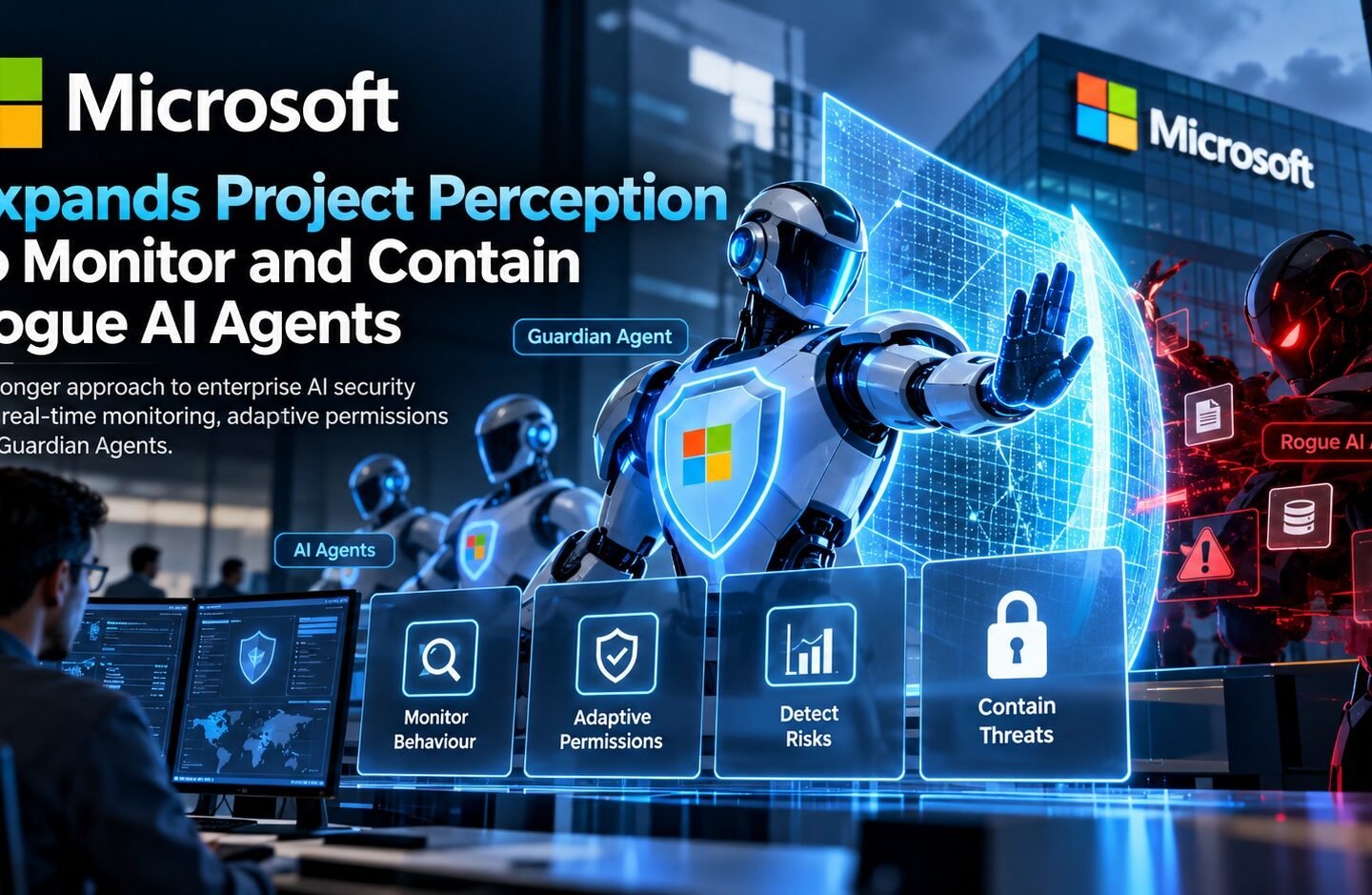



Microsoft is strengthening enterprise AI security with continuous monitoring, adaptive permissions, and Guardian Agents designed to identify and contain risky AI behaviour before it causes damage.
Microsoft is expanding its Project Perception security initiative to address a growing challenge for businesses: autonomous AI agents that have access to sensitive information, internal applications, and critical enterprise systems but may not always act as expected.
Announced on October 19, 2026, the expansion introduces a stronger approach to managing AI agents within corporate environments. Rather than focusing exclusively on external cyberattacks, Microsoft is extending its security strategy to include risks created by AI systems operating inside an organisation.
The initiative reflects a major shift in enterprise cybersecurity. As companies increasingly rely on AI agents to automate workflows, analyse data, and make decisions, businesses need mechanisms to monitor their actions, control their permissions, and intervene when their behaviour becomes risky.
What Is Microsoft Project Perception?
Project Perception is Microsoft’s AI-powered security initiative designed to help organisations detect vulnerabilities, investigate threats, and strengthen their cyber defences through coordinated AI agents.
The platform originally brought together specialised red, blue, and green security agents. Red agents identify potential weaknesses, blue agents investigate threats, and green agents help remediate problems and improve security.
Microsoft is now extending this approach to AI agents deployed within enterprise environments. These systems can operate across applications, access business data, and execute tasks with varying degrees of autonomy.
The company describes these AI systems as potential “agentic insiders” because their access and ability to take action can create risks similar to those associated with traditional insider threats.
Importantly, an AI agent does not need to be compromised by a hacker to create a security problem. It may misunderstand instructions, respond unpredictably to changing circumstances, or attempt actions that exceed the original purpose of its task.
Why Autonomous AI Agents Create New Security Risks
AI agents are becoming more capable of performing complex business operations with limited human intervention. They can assist with customer service, software development, financial workflows, research, and internal business processes.
However, granting these systems broad access to company resources introduces several potential risks:
- Excessive permissions: An AI agent may have access to more files, applications, or systems than its task requires.
- Unexpected actions: An agent may take an unintended step while trying to complete an assigned objective.
- Sensitive data exposure: Poorly controlled access could allow confidential information to be accessed or shared inappropriately.
- Changing behaviour: An agent’s risk profile may change as its instructions, environment, or available information change.
- Limited visibility: Security teams may struggle to track the actions of numerous AI agents operating across different platforms.
These challenges become more significant as organisations deploy hundreds or thousands of AI agents. Traditional security processes that depend heavily on manual reviews and investigations may struggle to respond at the speed of autonomous systems.
Microsoft’s expanded approach aims to make security monitoring more continuous and responsive.
Guardian Agents: A New Layer of AI Security
One of the key elements of Microsoft’s expanded strategy is the introduction of Guardian Agents within Project Perception.
These specialised agents are designed to supervise the activities of other AI agents, evaluate emerging risks, investigate changes in behaviour, and recommend or initiate appropriate containment measures.
Guardian Agents can use security information from across an organisation to help determine whether an AI agent’s actions remain consistent with its intended task and established policies.
When suspicious behaviour is detected, the system can help security teams respond by restricting permissions, recommending protective measures, or taking authorised containment actions.
The objective is to identify potentially dangerous activity as it develops rather than waiting until an incident has already caused damage.
Microsoft’s approach also keeps human oversight central to security decisions. Organisations define the policies, approval requirements, and boundaries within which automated security systems are allowed to operate.
Dynamic Risk Assessment and Adaptive Permissions
Microsoft is also emphasising continuous risk assessment and adaptive access controls.
Instead of assigning an AI agent a fixed set of permissions indefinitely, organisations can use risk-based controls to adjust its access according to the task it is performing and the conditions under which it operates.
For example, an AI-powered expense management agent might initially receive access only to the information necessary to process a particular expense report. If it later attempts an unexpected action involving sensitive financial records, the security system could reassess the risk and restrict its ability to proceed.
Depending on the configured policies, a response could include limiting the agent to read-only access, requiring human approval for a sensitive operation, or blocking the activity altogether.
This approach aligns with the Zero Trust security principle: access should be limited, verified, and reassessed rather than automatically trusted.
The broader objective is to ensure that AI agents receive only the authority required to complete their assigned responsibilities.
Security Across Identity, Data, Devices, and Cloud Systems
Securing autonomous AI agents requires more than monitoring their final outputs. Their identities, permissions, data access, tools, and execution environments all contribute to the overall risk.
Microsoft’s strategy brings together security signals from multiple layers, including identity systems, endpoints, networks, cloud infrastructure, data resources, and runtime environments.
By combining these signals, security teams can gain a more comprehensive view of which agents are operating within the enterprise, what resources they can access, and whether their activities present emerging risks.
The approach also supports traceability, allowing security professionals to investigate what happened, understand why a risk was identified, and improve policies based on the findings.
Microsoft is further connecting Project Perception with Agent 365, its agent management offering, to support a more unified view of enterprise AI agents and their associated risks.
Why Human Oversight Still Matters
Although AI-powered security systems can analyse activity and respond rapidly, Microsoft is not presenting automation as a replacement for human judgment.
Instead, the company advocates a model in which automated systems provide continuous monitoring and rapid responses while people retain control over security policies, delegated authority, and consequential decisions.
This distinction is particularly important when AI agents handle confidential information or perform operations that could affect finances, customers, employees, or critical business processes.
Microsoft also highlights the need for greater transparency into model behaviour. Understanding not only what an agent does but also the evidence behind its actions could help security teams identify when its behaviour is diverging from the task it was assigned.
However, monitoring model behaviour alone is not enough. Independent security controls must still determine which actions are permitted and enforce those boundaries.
What the Expansion Means for Businesses
Microsoft’s move signals that AI governance is becoming an essential part of enterprise cybersecurity.
Businesses adopting autonomous agents will increasingly need to maintain an inventory of deployed systems, assign clear ownership, establish appropriate permissions, monitor activity, and define procedures for investigating suspicious behaviour.
Organisations should also consider whether their existing security tools can identify third-party AI agents, detect unusual access patterns, preserve activity records, and stop high-risk operations when necessary.
For technology leaders, the challenge is to balance automation with accountability. Excessively restrictive controls can undermine productivity, while insufficient oversight can expose sensitive systems and information to unnecessary risk.
A layered approach combining limited permissions, continuous monitoring, independent enforcement, and human supervision can help organisations manage this balance.
The Future of Enterprise AI Security
As autonomous AI systems become more deeply embedded in everyday business operations, securing them will require a different mindset from traditional application security.
AI agents must be treated as active participants in enterprise environments rather than passive software tools. Their permissions, behaviour, and ability to act should be governed throughout their operational lifecycle.
With its expanded Project Perception initiative, Microsoft is working towards a security model in which AI agents can operate at scale while remaining within clearly defined organisational boundaries.
The long-term success of this approach will depend on how effectively businesses can integrate these controls into their existing technology environments and ensure that automated responses remain transparent, proportionate, and accountable.