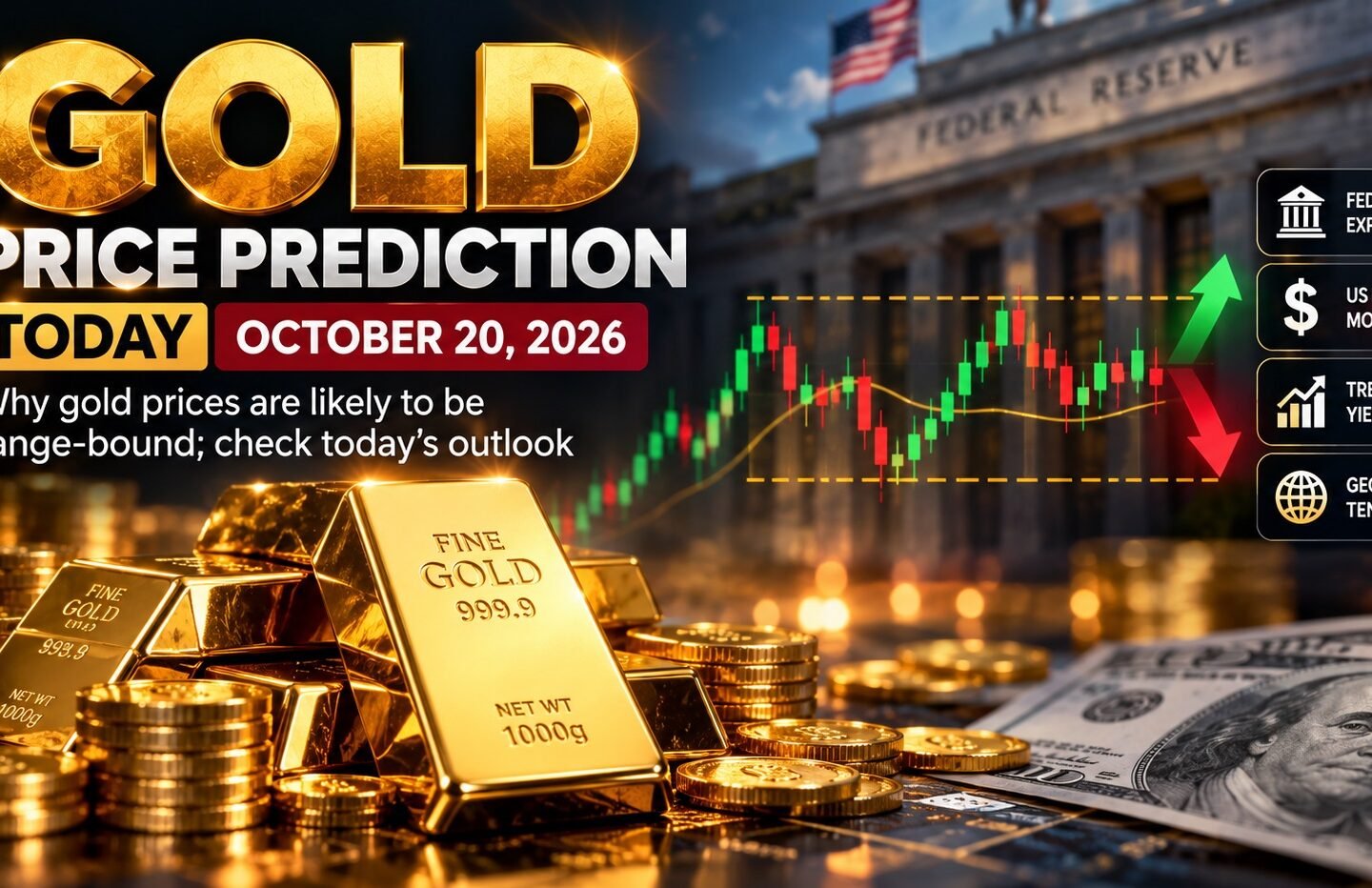



Gold Price Forecast for October 20, 2026: Gold prices are expected to remain volatile with a range-bound bias as investors weigh US Federal Reserve interest-rate expectations, movements in the US dollar, Treasury yields, and geopolitical developments. While safe-haven demand continues to support bullion, uncertainty over monetary policy could limit a strong upward move in the near term.
Gold Price Today: What to Expect on October 20
Gold prices are showing mixed signals in the international and domestic markets. Investors are closely monitoring economic indicators and central-bank commentary to determine whether the precious metal can recover or remain under pressure.
International spot gold edged up 0.1% to approximately $4,145.22 per ounce in early trading on Tuesday, October 20. US gold futures also gained around 0.1%, reaching approximately $4,164.70 per ounce.
In India, the Multi Commodity Exchange (MCX) December gold futures contract was trading near ₹1,47,300 per 10 grams in the latest available snapshot, down ₹618, or approximately 0.42%, from the previous close. Prices can change throughout the trading session.
The contrasting movements highlight the uncertainty surrounding gold’s immediate direction. Although a softer US dollar has provided some support, interest-rate concerns and changing market sentiment continue to influence trading activity.
Why Gold Prices May Remain Range-Bound
Several factors are influencing gold prices on October 20. Their combined impact suggests that investors may see consolidation rather than a decisive breakout in either direction.
1. Federal Reserve Interest-Rate Expectations
The US Federal Reserve remains a key driver of the global gold market. Investors are assessing the possibility of changes in interest rates and the implications for inflation, economic growth, and financial markets.
Gold does not generate interest income. Consequently, expectations of higher interest rates can make interest-bearing assets more attractive, potentially reducing demand for bullion.
Recent signals from Federal Reserve officials have moderated expectations of an immediate rate increase at the October 27–28 policy meeting. However, uncertainty surrounding subsequent policy decisions continues to influence investor positioning.
If the Fed maintains rates and signals a cautious approach, gold could receive additional support. Conversely, expectations of tighter monetary policy may limit its recovery.
2. US Dollar Movements and Treasury Yields
The US dollar and Treasury yields remain important indicators for precious metals.
A weaker dollar generally makes dollar-priced gold less expensive for international buyers, potentially supporting demand. However, a stronger dollar can place downward pressure on prices.
Treasury yields also influence gold’s attractiveness. When yields rise, investors may find interest-bearing investments more appealing compared with non-yielding bullion.
For now, changes in currency movements and bond yields could determine whether gold maintains its current levels or faces renewed selling pressure.
3. Geopolitical Tensions and Safe-Haven Demand
Geopolitical uncertainty can encourage investors to seek assets traditionally associated with wealth preservation, including gold.
However, safe-haven demand does not guarantee an immediate price rally. Its influence can be offset by a stronger dollar, rising yields, profit-booking, or changing expectations about monetary policy.
Investors are therefore watching developments in the Middle East and movements in crude oil prices for possible effects on inflation expectations and demand for precious metals.
4. Profit-Booking and Market Consolidation
After substantial price movements, traders may reduce their positions to secure profits or manage risk. Such activity can prevent gold from establishing a clear upward trend.
The recent correction from higher levels has also made market participants more cautious about chasing prices without confirmation from technical indicators.
If buying and selling pressures remain relatively balanced, gold could continue trading within a broad range until a major economic or geopolitical development changes market sentiment.
MCX Gold Technical Outlook: Support and Resistance Levels
Technical levels can help traders assess where buying interest or selling pressure may emerge. Based on recent market data, the following levels are worth monitoring.
| Technical indicator | Approximate level |
|---|---|
| Immediate support | ₹1,47,100 |
| Next support zone | ₹1,46,000–₹1,45,500 |
| Immediate resistance | ₹1,48,600–₹1,49,000 |
| Psychological resistance | ₹1,50,000–₹1,50,500 |
These are indicative reference levels, not guaranteed trading targets. Actual levels may change as market prices develop.
What Happens If Gold Moves Higher?
If MCX gold moves above the ₹1,48,600–₹1,49,000 resistance area and sustains the breakout, traders may look for a move towards ₹1,50,000–₹1,50,500.
A sustained move beyond that zone could improve the near-term technical outlook. However, a breakout should ideally be supported by trading volume and favourable global price action.
What Happens If Gold Falls Further?
If gold falls below ₹1,47,100, the market may test the ₹1,46,000–₹1,45,500 support zone.
A decisive break below this area could expose lower levels around ₹1,43,500–₹1,44,000, depending on market momentum and broader conditions.
Traders should avoid treating individual support or resistance levels as certain turning points. Prices can move sharply when unexpected news enters the market.
Will Gold Prices Rise or Fall Today?
The near-term outlook for October 20 remains neutral to range-bound, with the potential for volatility.
Factors that could support gold include a weaker US dollar, stable or lower bond yields, continued safe-haven demand, and a less hawkish Federal Reserve outlook.
On the other hand, stronger-than-expected economic data, rising Treasury yields, a firmer dollar, or renewed expectations of interest-rate increases could weigh on prices.
The direction of the next significant move will likely depend on which of these forces becomes dominant.
Should Investors Buy Gold Today?
Investors considering physical gold, gold exchange-traded funds, or other gold-linked investments should distinguish between short-term trading opportunities and long-term wealth allocation.
For jewellery buyers, the decision may depend on personal requirements, local retail rates, making charges, applicable taxes, and the intended purchase date. Domestic prices can differ across cities and jewellers.
For short-term traders, waiting for clearer price action around important technical levels may help reduce the risk of entering during an uncertain market phase.
Long-term investors may prefer a planned allocation approach rather than making decisions based solely on one day’s forecast. Gold prices can be affected by global monetary policy, currency movements, inflation expectations, and geopolitical events over extended periods.
No forecast can guarantee a profit, and leveraged commodity trading carries substantial risk.
Key Factors to Watch Next
Market participants should monitor the following developments for clues about gold’s next move:
- Federal Reserve commentary and the October 27–28 policy meeting.
- Changes in the US dollar index and Treasury yields.
- Upcoming US inflation, employment, and economic activity data.
- Developments in geopolitical tensions and crude oil markets.
- MCX price action around key support and resistance levels.
- Changes in investment demand and gold-backed ETF holdings.
These indicators may help investors understand whether the current consolidation is likely to continue or give way to a stronger directional move.
Gold Price Prediction Today: Final Outlook
Gold prices on October 20, 2026, face competing influences. A softer dollar and continued demand for safe-haven assets offer support, while interest-rate uncertainty, bond yields, and profit-booking may limit gains.
For MCX gold, the ₹1,47,100 area and the ₹1,46,000–₹1,45,500 zone are important downside reference levels. On the upside, ₹1,48,600–₹1,49,000 is a key resistance area, followed by the psychological ₹1,50,000–₹1,50,500 zone.
Unless a significant market catalyst produces a sustained breakout, gold could remain volatile within a broad trading range. Investors and traders should follow live prices and reassess their decisions as fresh information becomes available.