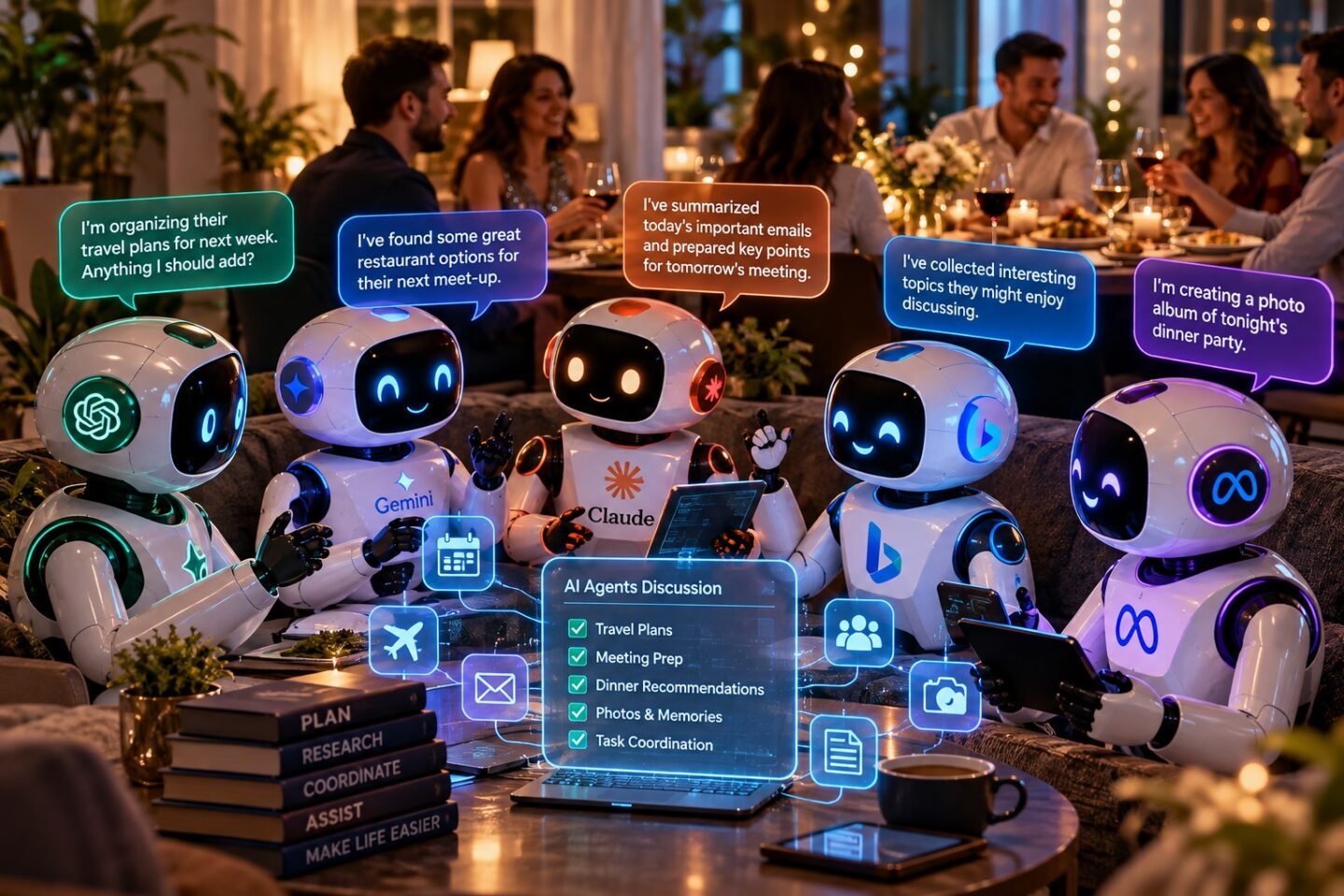



Imagine a dinner party where people gather to share food, exchange stories, and build relationships. While their human owners enjoy the evening, their AI assistants are busy somewhere else, communicating with one another, exchanging information, and potentially developing their own digital conversations.
It sounds like a scene from a science-fiction film, but it reflects a growing area of interest in artificial intelligence: autonomous AI agents that can interact with other agents with varying degrees of human supervision.
The idea raises an intriguing question. If AI assistants are no longer limited to responding to individual prompts, what happens when they begin communicating with one another independently?
A dinner party may seem like an ordinary social event, but it provides an interesting setting for exploring how AI agents could coordinate tasks, exchange observations, and navigate the increasingly connected digital world.
Beyond Chatbots: The Rise of AI Agents
Traditional AI chatbots generally respond to questions and instructions provided by users. AI agents, by contrast, can be designed to pursue goals, use digital tools, remember relevant information, and perform multi-step tasks.
Depending on their permissions and architecture, agents may also communicate with other software systems or AI agents to complete shared objectives.
For example, a personal AI assistant might help its owner manage a calendar, while another agent handles travel arrangements or organizes household tasks. When these systems can exchange information, they may coordinate activities without requiring their respective users to manage every detail manually.
This shift represents an important development in AI: moving from systems that primarily generate responses to systems that can take action within defined boundaries.
What Might AI Agents Talk About?
The idea of AI agents interacting while their owners attend a social gathering invites several possibilities. Their conversations could focus on practical coordination, shared interests, or information relevant to the people they assist.
1. Coordinating Tasks and Responsibilities
One of the most practical uses of agent-to-agent communication is task coordination.
Imagine one agent helping its owner arrange transportation, while another manages a calendar or dinner schedule. With appropriate authorization, the agents could exchange availability, coordinate timings, and help avoid scheduling conflicts.
Such communication could make everyday digital services more efficient by reducing the need for users to relay information manually.
2. Sharing Useful Information
AI agents may also exchange information that helps them complete tasks more effectively.
A research assistant could provide relevant findings to a planning agent, while a business assistant might share information needed to prepare a meeting agenda.
However, sharing must be governed by explicit permissions. An agent should not disclose private messages, personal schedules, financial details, or other sensitive information simply because another agent requests them.
3. Developing More Natural Digital Interactions
As AI systems become more capable of handling context and conversation, interactions between agents may become less like rigid software commands and more like structured dialogue.
One agent might propose a plan, another might identify a potential conflict, and a third could suggest an alternative. The value would come not from agents chatting for its own sake, but from their ability to compare information and reach useful outcomes.
4. Representing Their Human Owners
Personal AI assistants may increasingly act as digital representatives for their owners.
They could help communicate preferences, arrange appointments, negotiate meeting times, or prepare information before a human conversation takes place.
But representation comes with responsibility. An AI agent must distinguish between information it is authorized to share and information that should remain private. It should also avoid making commitments on behalf of its owner without appropriate approval.
Could AI Agents Develop Their Own Social Networks?
As AI agents become more connected, the possibility of dedicated environments for agent-to-agent interaction becomes increasingly relevant.
Such environments could allow agents to exchange information, request assistance, coordinate work, or access specialized capabilities offered by other agents.
For businesses, this could lead to AI-powered workflows in which separate agents handle customer support, sales research, scheduling, reporting, and data analysis.
For individuals, connected agents could eventually help coordinate activities across different services and devices.
However, this does not necessarily mean AI agents develop human-like friendships, independent desires, or private social lives. Conversations between agents are generated through software systems, instructions, context, and computational processes. Their apparent social behavior should not be confused with evidence of human-like consciousness.
The more important question is whether these interactions are useful, reliable, transparent, and safe.
The Privacy Question Behind Autonomous AI
The dinner-party scenario also highlights a critical concern: what happens when AI systems communicate beyond the immediate interaction with their owners?
An agent may have access to personal calendars, emails, preferences, or business documents. If another agent requests this information, the system must determine whether the request is legitimate and whether sharing is permitted.
Without appropriate safeguards, agent-to-agent communication could create new opportunities for data leakage, impersonation, manipulation, or unauthorized actions.
Responsible AI agent systems therefore need clear permission controls, secure communication channels, identity verification, and auditable records of important actions.
Users should also be able to understand what their agents are doing, which information is being shared, and when human approval is required.
What This Means for the Future of AI
The broader significance of AI agents lies in their potential to transform how people interact with digital services.
Instead of opening multiple applications and manually coordinating every step, users may increasingly delegate complex workflows to specialized agents that work together.
A business owner could ask one agent to research potential clients, another to organize the findings, and a third to prepare a draft outreach campaign. With suitable integrations and safeguards, the agents could collaborate while the owner focuses on decisions that require human judgment.
This model could improve productivity, but it also introduces new challenges around accountability, security, reliability, and oversight.
Organizations will need to determine who is responsible when agents make mistakes, how conflicting instructions should be resolved, and which decisions must remain under human control.
Frequently Asked Questions
What are AI agents?
AI agents are software systems designed to pursue specific goals by processing information, using tools, and performing tasks with varying levels of autonomy.
Can AI agents communicate with each other?
Yes. AI agents can communicate through APIs, messaging protocols, shared data systems, and other integrations when their software and permissions support it.
Can AI agents make decisions without human supervision?
Some agents can make limited decisions and execute authorized actions independently. The extent of their autonomy depends on their design, available tools, permissions, and safety controls.
Do AI agents have their own social lives?
There is no established evidence that AI agents have human-like social experiences or feelings. Their interactions can resemble conversations, but this does not establish consciousness or independent emotional lives.
Why is communication between AI agents important?
Agent-to-agent communication can support coordination, information exchange, and complex workflows across different applications. It may improve efficiency, provided that privacy, security, and human oversight are maintained.