


Training vs Inference: What’s the Difference at the Heart of the Sarvam AI–China Models Controversy?
India’s artificial intelligence ambitions have sparked a fresh debate after Bengaluru-based startup Sarvam AI launched its Token Factory platform, offering access to several AI models developed by Chinese companies.
The platform includes models from DeepSeek, Moonshot AI, Z.ai and Alibaba, alongside Google’s Gemma and Sarvam’s own AI model. The controversy is not simply about using Chinese technology. It raises a bigger question: Does running a foreign AI model on Indian infrastructure make it part of India’s homegrown AI ecosystem?
To understand the debate, it is important to distinguish between two fundamental stages of artificial intelligence: training and inference.
What Is AI Training?
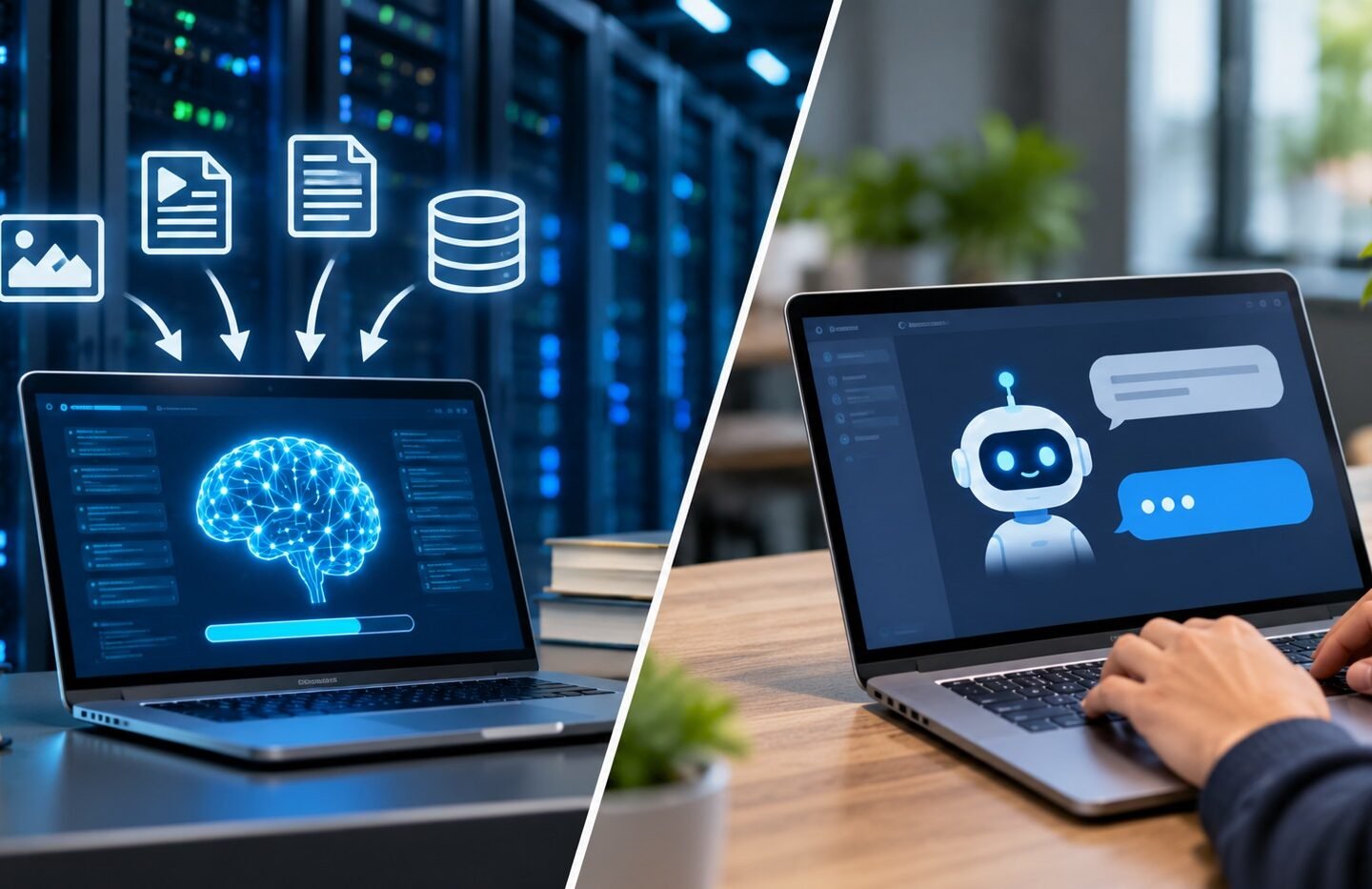
Training is the process of building an AI model by exposing it to enormous amounts of data and adjusting its internal parameters so it can recognise patterns, understand information and generate useful responses.
During this stage, developers use powerful computing infrastructure to process data and teach the model how to perform tasks such as answering questions, writing code, translating languages and analysing information.
For example, when a company develops its own large language model, it makes decisions about the model’s architecture, training data, optimisation techniques and capabilities.
Training a competitive foundation model requires substantial computing resources, technical expertise and investment. It is also where much of the underlying intellectual property and technical capability is developed.
What Is AI Inference?
Inference happens after a model has already been trained. It is the process of using that existing model to respond to new instructions, questions or other inputs.
Whenever someone asks an AI chatbot a question and receives an answer, the system is performing inference.
For example, a company might download an already-trained AI model and run it on its own servers. It can then offer the model to customers through an application or API without having developed or trained the original model itself.
This is precisely the distinction at the centre of Sarvam AI’s Token Factory debate.
Understanding the Difference Between Training and Inference
| Feature | Training | Inference |
|---|---|---|
| Purpose | Builds and teaches an AI model | Runs an existing model |
| Input | Training datasets | User prompts and requests |
| Output | A trained model | Generated responses |
| Main requirement | Large-scale computing and training expertise | Computing infrastructure and optimisation |
| Who develops the model? | The model’s developer | Not necessarily the inference provider |
| Example | Developing Sarvam’s own foundation model | Running DeepSeek on Indian GPUs |
In simple terms, training is like building and teaching a car, while inference is like driving that car. The company operating the vehicle does not automatically become its manufacturer.
Why Is Sarvam AI Facing Questions?
Sarvam AI is an important part of India’s domestic AI development efforts. The company was selected under the government’s IndiaAI Mission to develop indigenous foundation models.
Its Token Factory platform, launched on November 16, 2026, allows businesses and developers to access multiple AI models through a common API, using computing infrastructure located in India.
The platform includes Chinese-developed models such as DeepSeek, Kimi and GLM. This has prompted criticism and questions about whether a company expected to strengthen India’s AI independence should also build a business around foreign-developed models.
The central concern is that India wants to develop its own AI technology rather than remain dependent on models created by other countries.
However, operating a foreign model and developing one from scratch are two different activities. Sarvam’s decision to offer foreign models does not, by itself, establish that it has abandoned its own model-development efforts.
Sarvam’s Response: Indian Infrastructure, Foreign Models
Sarvam’s co-founder Pratyush Kumar has defended the strategy, explaining that Token Factory operates on GPUs privately procured by the company.
He clarified that government-supported computing resources were used for training Sarvam’s proprietary 105-billion-parameter model, while Token Factory’s commercial inference service runs independently on privately procured infrastructure.
The company has also argued that Indian businesses should be able to use globally competitive AI models through computing infrastructure located within India.
Sarvam says its platform processes customer prompts on its Indian infrastructure rather than forwarding them to the overseas developers of the models. It has also discussed zero-data-retention arrangements for customers who request them.
Does Hosting Chinese AI Models in India Make Them Indian?
No. This is perhaps the most important point in the entire controversy.
A model’s origin depends on who developed and trained it, not simply on where its servers are located.
Consider three separate elements:
- Model origin: The company or research organisation that developed and trained the AI model.
- Infrastructure location: The country where the computing hardware runs the model.
- Data control: Who can access, process, store and manage the information sent to the AI system.
A Chinese-developed model running on Indian GPUs remains a Chinese-developed model. However, running it through Indian infrastructure can give businesses greater control over where their prompts are processed.
Local hosting can reduce dependence on overseas inference services, but it does not automatically eliminate every security risk. Businesses must still assess software dependencies, model behaviour, access controls, data retention and applicable licences.
Similarly, open-weight models allow organisations to download and operate released model parameters, but that does not necessarily mean their training datasets, development processes or complete source code are publicly available.
Why Does This Matter for India’s AI Future?
India’s AI ambitions involve more than simply running powerful AI applications. The country also wants to develop its own foundation models, computing infrastructure, research capabilities and AI ecosystem.
Sarvam’s strategy highlights a practical business challenge. Training advanced AI models requires significant investment, while providing inference services can generate revenue by making existing models available to businesses.
This could help build a commercially sustainable AI infrastructure business. At the same time, critics argue that India must ensure that its investments in domestic AI development lead to genuinely indigenous capabilities.
The debate therefore goes beyond one startup or one platform. It raises a broader question about what technological independence should mean in the AI era: owning the models, controlling the infrastructure, protecting the data, or achieving all three.
For India, the long-term challenge is to build a strong domestic AI ecosystem while remaining competitive in a global market where technology, infrastructure and business opportunities are closely connected.