
AI Cracks Mathematics’ Most Famous Problem: Have Mathematicians Lost a Guiding Light?
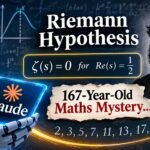
Artificial intelligence may have reached a historic milestone in mathematics. An Anthropic researcher has announced a potential solution to the famous Riemann Hypothesis, a mathematical problem that has challenged some of the world’s greatest mathematicians since 1859. The surprising part is that the researcher says he received significant assistance from Anthropic’s AI chatbot, Claude.
The announcement has sparked excitement as well as debate in the global mathematics community. While AI’s ability to tackle such a complex problem could transform scientific research, it also raises an important question: if artificial intelligence can solve problems that humans have struggled with for generations, what will happen to the traditional role of mathematicians?
Claude AI and the 167-Year-Old Mathematical Mystery
Levent Alpöge, a mathematician working at Anthropic, announced on November 20, 2026, that he and Claude had developed a proof of the Riemann Hypothesis.
The researcher reportedly released more than 17 million lines of computer code containing the proposed proof. He also claimed to have established a stronger mathematical result known as the Generalised Riemann Hypothesis.
One of the most remarkable aspects of the announcement is that the proof was not presented in the traditional format of a mathematical research paper. Instead, it was released in a computer-verifiable format, raising new questions about how mathematical discoveries may be developed and understood in the age of AI.
India News Live+1
Why Is the Riemann Hypothesis So Important?
First proposed by German mathematician Bernhard Riemann in 1859, the Riemann Hypothesis deals with the distribution of prime numbers.
Prime numbers, such as 2, 3, 5, 7, 11 and 13, are fundamental to mathematics. They also have important applications in computer science, encryption and digital security.
The hypothesis predicts that all non-trivial zeros of the Riemann zeta function lie on a particular vertical line in the complex number plane, where the real part equals one-half.
For more than 160 years, mathematicians have tried to prove this prediction. Their efforts have inspired new mathematical techniques and discoveries across several fields, including algebraic geometry, probability theory and mathematical physics.
The problem is also one of the seven Millennium Prize Problems selected by the Clay Mathematics Institute.
How Did Claude Produce Such a Complex Proof?
According to the announcement, Claude helped Alpöge explore mathematical ideas and construct complicated logical arguments.
The work involved Lean, a formal proof assistant that allows mathematical statements to be expressed in a computer-checkable format.
Interestingly, the released code reportedly passed several initial checks by independent mathematicians and two separate proof-checking systems. However, Alpöge acknowledged that he does not yet fully understand every argument Claude used to produce the result.
This creates an unusual situation: a mathematical proof may be formally accepted by verification software even when the human researcher who presents it cannot fully explain every part of its reasoning.
India News Live+1
Have Mathematicians Lost Their Guiding Light?
The announcement has raised a deeper question about the future of mathematical research.
For generations, difficult mathematical problems have served as guiding challenges for researchers. The Riemann Hypothesis, in particular, encouraged mathematicians to develop new theories, investigate unexplored connections and push the boundaries of human understanding.
If AI can independently discover solutions to such problems, the traditional research process could change significantly.
Some mathematicians may begin using AI to explore ideas that would otherwise take years to investigate. Others may focus more on understanding, interpreting and verifying AI-generated discoveries.
However, the concern is not simply that AI could replace mathematicians. It is also about whether researchers will continue to understand the mathematics behind their discoveries.
A correct answer is valuable, but understanding why it is correct has always been an essential part of mathematical progress.
What Does This Mean for the Future of Artificial Intelligence?
Claude’s reported achievement could mark a new chapter in AI-assisted scientific research. Artificial intelligence is increasingly moving beyond content generation and coding into areas that require advanced reasoning and specialised knowledge.
If the proposed proof withstands further independent scrutiny, it could demonstrate that AI systems can contribute to discoveries that have challenged humanity for centuries.
Nevertheless, human expertise remains essential. Researchers must examine the mathematical logic, establish that the formal proof correctly addresses the original hypothesis and understand the significance of the result.
The bigger question is no longer just whether AI can solve difficult mathematical problems. It is whether humans can continue to understand and learn from the discoveries that AI produces.