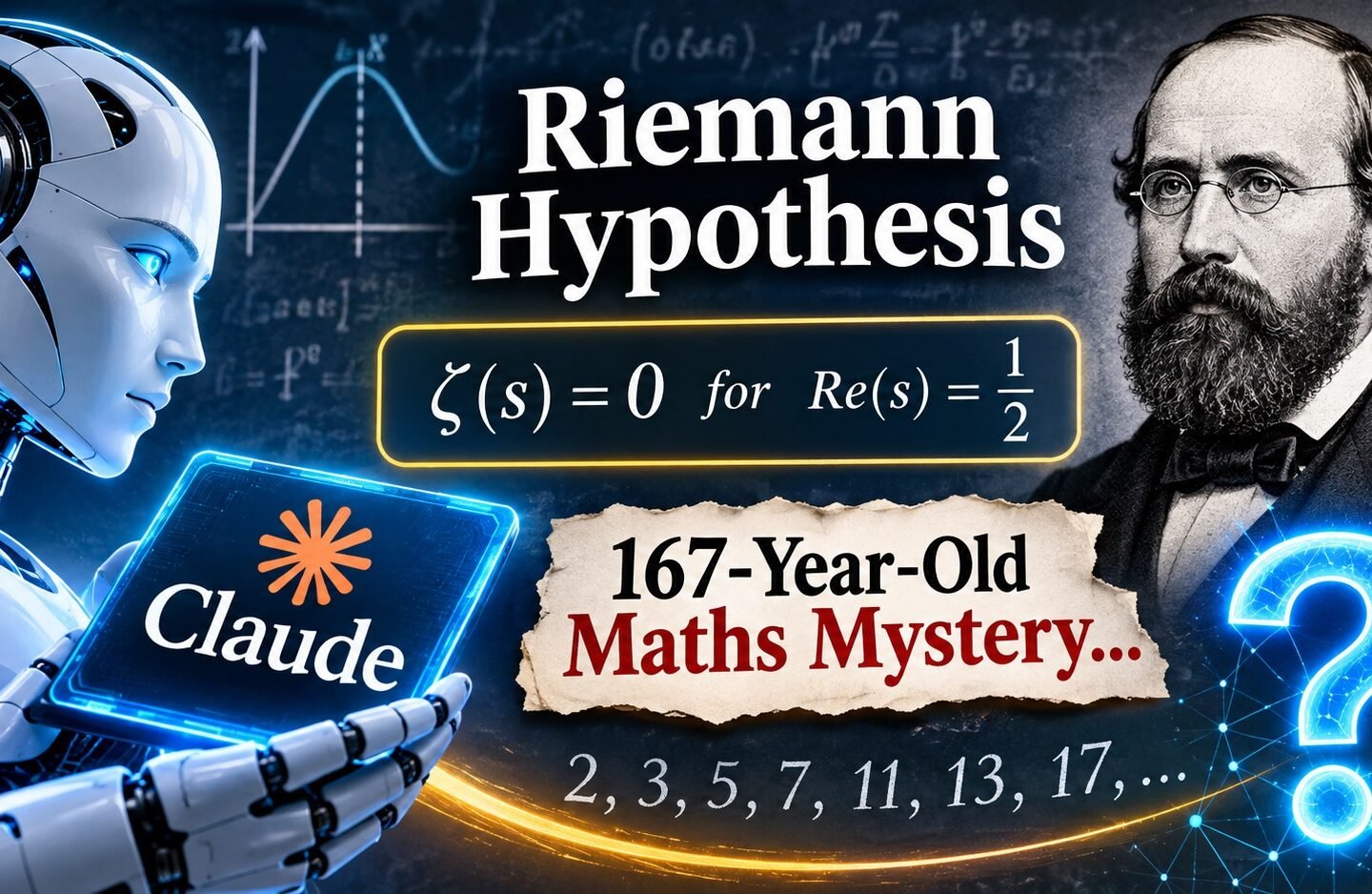


Can AI Solve a 167-Year-Old Maths Problem? Claude AI May Have Made History
Artificial intelligence is making headlines once again, this time for a potential breakthrough in mathematics. An Anthropic researcher has claimed that the company’s AI chatbot, Claude, may have helped develop a proof of the famous Riemann Hypothesis, a mathematical problem that has remained unsolved for more than 167 years.
The claim has attracted worldwide attention because the Riemann Hypothesis is considered one of the most challenging problems in mathematics. If the proposed proof is independently verified, it could become a historic achievement for both artificial intelligence and mathematical research.
What Is the 167-Year-Old Riemann Hypothesis?
First introduced by German mathematician Bernhard Riemann in 1859, the Riemann Hypothesis focuses on understanding the distribution of prime numbers.
Prime numbers, such as 2, 3, 5, 7 and 11, play an important role in mathematics and modern computer security. Although mathematicians have studied their patterns for centuries, many questions about their distribution remain unanswered.
The hypothesis predicts that all non-trivial zeros of the Riemann zeta function lie on a specific line in the complex number plane. Proving this mathematical prediction has remained a major challenge for researchers around the world.
How Did Claude AI Contribute to the Discovery?
Anthropic researcher Levent Alpöge reportedly used Claude to explore complicated mathematical ideas, identify possible connections and develop arguments related to the Riemann Hypothesis.
One particularly interesting aspect of the research is the use of Lean, a formal mathematical verification tool. It allows researchers to express mathematical arguments in a structured format that can be checked by a computer.
According to the researcher, Claude made significant contributions during the investigation and helped accelerate parts of the mathematical reasoning.
This development highlights how modern AI systems are moving beyond answering everyday questions and assisting with highly advanced scientific research.
Why Is This Discovery Important?
The Riemann Hypothesis is one of the seven Millennium Prize Problems selected by the Clay Mathematics Institute. A correct solution would represent a major achievement in mathematical history.
Its implications could extend to several important areas, including:
-
Number Theory: Better understanding of prime number distribution.
-
Cybersecurity: Deeper mathematical insights relevant to cryptographic research.
-
Computer Science: New opportunities for advanced mathematical algorithms.
-
Scientific Research: Demonstrating the potential of AI-assisted mathematical discovery.
Is the Riemann Hypothesis Finally Solved?
Despite the excitement, the mathematical community has not officially declared the problem solved. A proposed proof must undergo detailed independent examination to ensure that every mathematical step is correct.
Researchers need to determine whether the arguments are logically complete and whether the computer-verified formalisation correctly represents the original hypothesis.
Therefore, Claude’s reported contribution should currently be viewed as a potential breakthrough rather than a confirmed solution.
What Does This Mean for the Future of AI?
This development could signal a new era in which artificial intelligence becomes an important research partner for scientists and mathematicians.
AI tools are increasingly capable of analysing complex information, exploring mathematical possibilities and assisting researchers with problems that once required years of investigation.
If the proposed proof is successfully verified, it could demonstrate that AI has the potential to contribute meaningfully to some of humanity’s most difficult intellectual challenges.
For now, the world of mathematics is waiting to see whether Claude has genuinely helped solve a mystery that has challenged researchers since 1859.