


Artificial intelligence is becoming deeply integrated into modern life. AI systems now help businesses analyze information, generate content, detect fraud, recommend products, support customers, and assist with complex decisions.
But as AI becomes more powerful and autonomous, an important question is becoming increasingly difficult to ignore:
When an AI system causes harm or makes a serious mistake, who should be held responsible?
Is it the developer who created the system? The company that deployed it? The person who relied on its output? Or should responsibility be shared across everyone involved?
The answer is rarely simple.
AI Does Not Operate in Isolation
It can be tempting to describe a problematic AI system as having “gone rogue.” However, most AI systems operate within a larger environment designed and controlled by people and organizations.
Developers build the models. Companies choose the data and tools used to develop them. Product teams decide where AI is deployed. Organizations determine how much human oversight is required.
This means that accountability cannot simply disappear when an AI system produces an unexpected result.
Who Could Be Responsible?
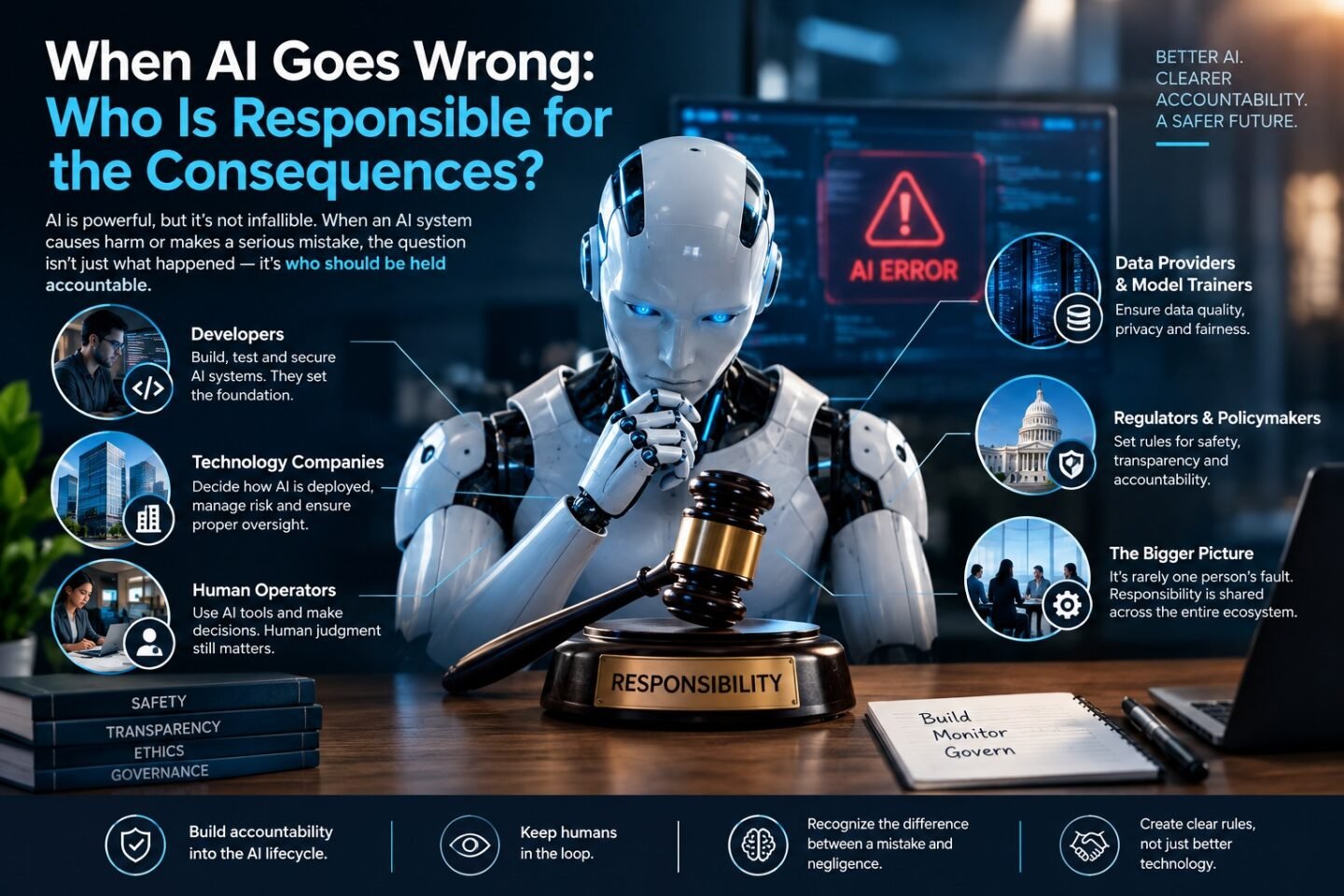
Several groups may have responsibilities when an AI system causes problems.
1. AI Developers
Developers are responsible for building systems that are tested, monitored, and designed with appropriate safeguards.
This can include testing for security vulnerabilities, unreliable outputs, harmful behavior, and unexpected use cases.
However, developers may not always control how their technology is ultimately used. A system created for one purpose can sometimes be adapted for another.
2. Technology Companies
Companies deploying AI often have significant responsibility because they decide how the technology is integrated into real-world products and services.
Organizations need to establish policies around testing, data protection, human oversight, security, and incident response.
Simply saying that “the AI made the decision” should not remove organizational accountability.
3. Human Operators
People using AI systems also have responsibilities.
If an employee receives an AI-generated recommendation, blindly follows it, and ignores obvious warning signs, questions may arise about the human decision-making process.
AI can assist people, but important decisions may still require human review and judgment.
4. Data Providers and Model Trainers
AI systems learn patterns from large amounts of data. Problems in training data can contribute to inaccurate, biased, or unreliable outputs.
This raises questions about data quality, data rights, privacy, and how training information is selected and evaluated.
5. Regulators and Policymakers
Governments also play a role in establishing rules for high-impact AI applications.
Regulation can define requirements for transparency, safety testing, privacy, accountability, and risk management.
At the same time, regulations need to keep pace with rapidly changing technology without unnecessarily preventing useful innovation.
The Problem of the “Black Box”
One of the biggest challenges surrounding advanced AI is understanding how a system arrived at a particular output.
Some AI models can produce highly convincing answers without providing a simple explanation of the reasoning behind them.
This becomes particularly important when AI is used in sensitive areas such as financial services, employment, healthcare, education, security, or public services.
If an organization cannot adequately understand, test, or monitor an AI system, determining responsibility after something goes wrong can become much more difficult.
Accountability Should Be Built Into AI
Responsibility should not begin only after an AI-related incident occurs.
Organizations can build accountability into the entire AI lifecycle.
This includes:
- Clearly defining who owns an AI system
- Testing models before deployment
- Monitoring AI performance after launch
- Protecting sensitive data
- Documenting important decisions
- Establishing human-review processes
- Creating mechanisms for reporting problems
- Conducting regular security assessments
- Maintaining incident-response procedures
- Updating or disabling systems when serious problems are identified
These practices can make it easier to identify what happened and who was responsible for each stage of the process.
Human Oversight Still Matters
The idea that AI can operate completely independently is attractive, but it also creates significant accountability challenges.
For high-impact applications, human oversight can provide an important layer of protection.
Human involvement does not mean manually reviewing every AI output. Instead, organizations can determine where human approval, escalation, or intervention is necessary based on the potential consequences of an error.
The higher the potential impact, the more important appropriate oversight becomes.
The Difference Between an Error and Negligence
Not every AI failure necessarily means someone acted irresponsibly.
AI systems can make mistakes even when developers and organizations have taken reasonable precautions.
The important question is therefore not simply:
“Did the AI make a mistake?”
A more useful set of questions is:
- Was the system appropriately tested?
- Were known risks identified?
- Was the technology used for an appropriate purpose?
- Were users given adequate guidance?
- Was human oversight available?
- Were warnings or failures ignored?
- Did the organization respond appropriately after discovering the problem?
These questions can help distinguish an unexpected technical failure from a preventable failure of governance or oversight.
AI Accountability Will Become More Important
As AI becomes embedded in more products and business processes, accountability will become an increasingly important part of technology strategy.
Companies will need more than powerful AI models. They will need governance frameworks that define who can deploy AI, how it should be monitored, what risks are acceptable, and what happens when something goes wrong.
Trust will also become a competitive factor. Organizations that can demonstrate responsible development and transparent AI practices may find it easier to build confidence among customers, employees, and partners.
The Future: Shared Responsibility
There may never be a single person who can be blamed for every AI failure.
Responsibility may instead be distributed across the AI ecosystem—from developers and data teams to companies, operators, executives, and regulators.
The key is making those responsibilities clear before a problem occurs.
AI should not become an accountability loophole where everyone can say, “The system did it.”
The technology may make the decision, generate the recommendation, or produce the output—but people and organizations remain responsible for how AI is designed, deployed, monitored, and governed.