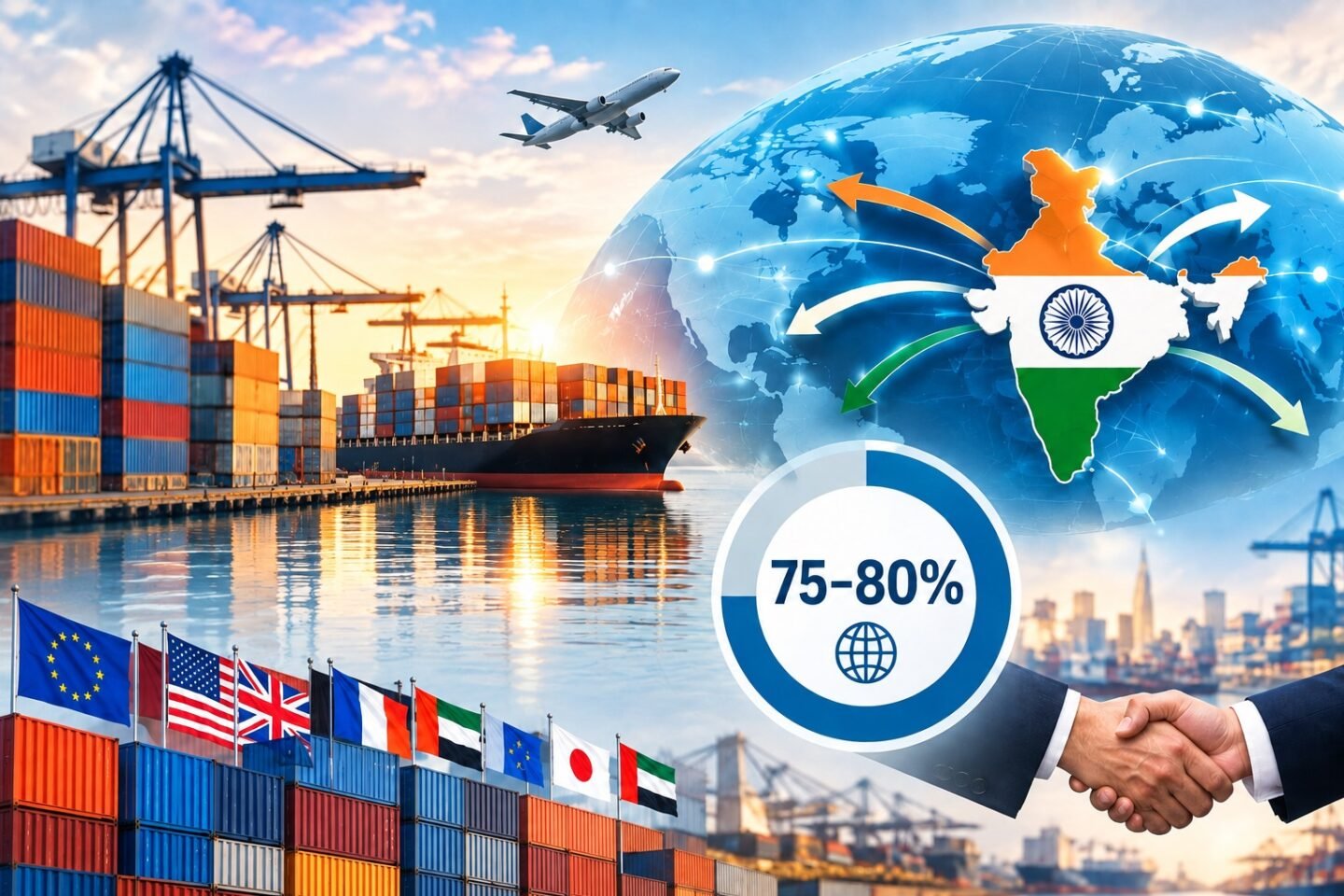


Commerce and Industry Minister Piyush Goyal has presented India as an increasingly important base for global trade and investment, saying the country’s expanding network of free trade agreements could eventually provide access to around 75–80% of the global economy.
India is stepping up efforts to strengthen its position in international trade as global supply chains continue to evolve and businesses look for new manufacturing and investment destinations.
Speaking during his visit to Chicago, Goyal highlighted India’s growing network of trade partnerships and urged American businesses, investors and innovators to deepen their engagement with the Indian market. According to reports, he said India’s free trade relationships could eventually cover economies representing around 75–80% of the world economy.
Expanding India’s global trade network
The government has been pursuing a broader network of Free Trade Agreements (FTAs) to improve market access for Indian exporters.
In September, Goyal said India’s nine FTAs covered economies with a combined GDP of about $60 trillion and provided preferential access to nearly two-thirds of global trade. He said additional agreements and deeper market access could take this figure toward 75% of global trade.
The strategy is aimed at creating more opportunities for Indian manufacturers, exporters, startups, traders and small businesses to reach international customers.
India has also been working on agreements with several major economies and trade blocs, adding to an expanding network of preferential market access.
Aiming for a $30 trillion economy
Goyal has linked India’s trade ambitions with the government’s longer-term economic objective of building a $30 trillion economy by 2047.
The minister has argued that achieving such a scale will require India to become more integrated with global markets rather than relying primarily on domestic demand.
The Commerce Ministry has also emphasised the need to ensure that smaller businesses and exporters understand and actually use the opportunities created by FTAs.
Focus on manufacturing and global supply chains
India’s trade strategy is also closely connected to its manufacturing ambitions.
At the G20 Trade Ministers’ Meeting in Milwaukee, Goyal described India as a large, domestic-demand-driven economy that is building manufacturing value chains ranging from design to finished products. He positioned India as a potential trusted link in global supply chains.
The government is seeking to attract international companies not only as buyers of Indian products but also as investors and manufacturing partners.
During his US visit, Goyal told American manufacturing and technology executives that India was prepared to facilitate investment, expansion and business operations. The discussions covered manufacturing, technology, innovation, investment and resilient supply chains.
New trade agreements add momentum
India’s recent trade activity illustrates the government’s effort to diversify and expand its export markets.
The India-New Zealand Free Trade Agreement, signed in April, is scheduled to enter into force on October 20, 2026. The agreement provides duty-free access for Indian goods in New Zealand and includes a commitment by New Zealand to invest $20 billion in India over 15 years.
India is also pursuing or implementing trade arrangements with other major economies, while discussions continue on additional agreements.
These deals are particularly significant as global trade faces changing tariff policies, geopolitical tensions and efforts by companies to diversify supply chains.
Opportunities and challenges ahead
India’s ambition to become a major global trade hub will depend not only on signing FTAs but also on how effectively Indian businesses use them.
Small and medium-sized enterprises may need greater awareness of tariff benefits, international standards, logistics, certification requirements and foreign-market regulations. The government has therefore been pushing for wider FTA outreach across districts and among MSMEs, traders, entrepreneurs and startups.
At the same time, changing trade policies in major markets could create uncertainty for exporters. India is negotiating with several partners while dealing with a more fragmented global trading environment.
India’s changing role in global commerce
Goyal’s comments reflect India’s broader effort to position the country as a manufacturing, investment and export destination with access to a wider group of international markets.
The stated goal of reaching 75–80% of the global economy through trade relationships represents an ambitious expansion of India’s market-access strategy. Whether that translates into higher exports, investment and manufacturing activity will depend on the implementation of trade agreements and the ability of Indian companies to compete effectively in international markets.
For India, the broader objective is clear: use trade partnerships, manufacturing capacity and investment opportunities to build a stronger presence in global commerce while moving toward the government’s long-term economic ambitions.