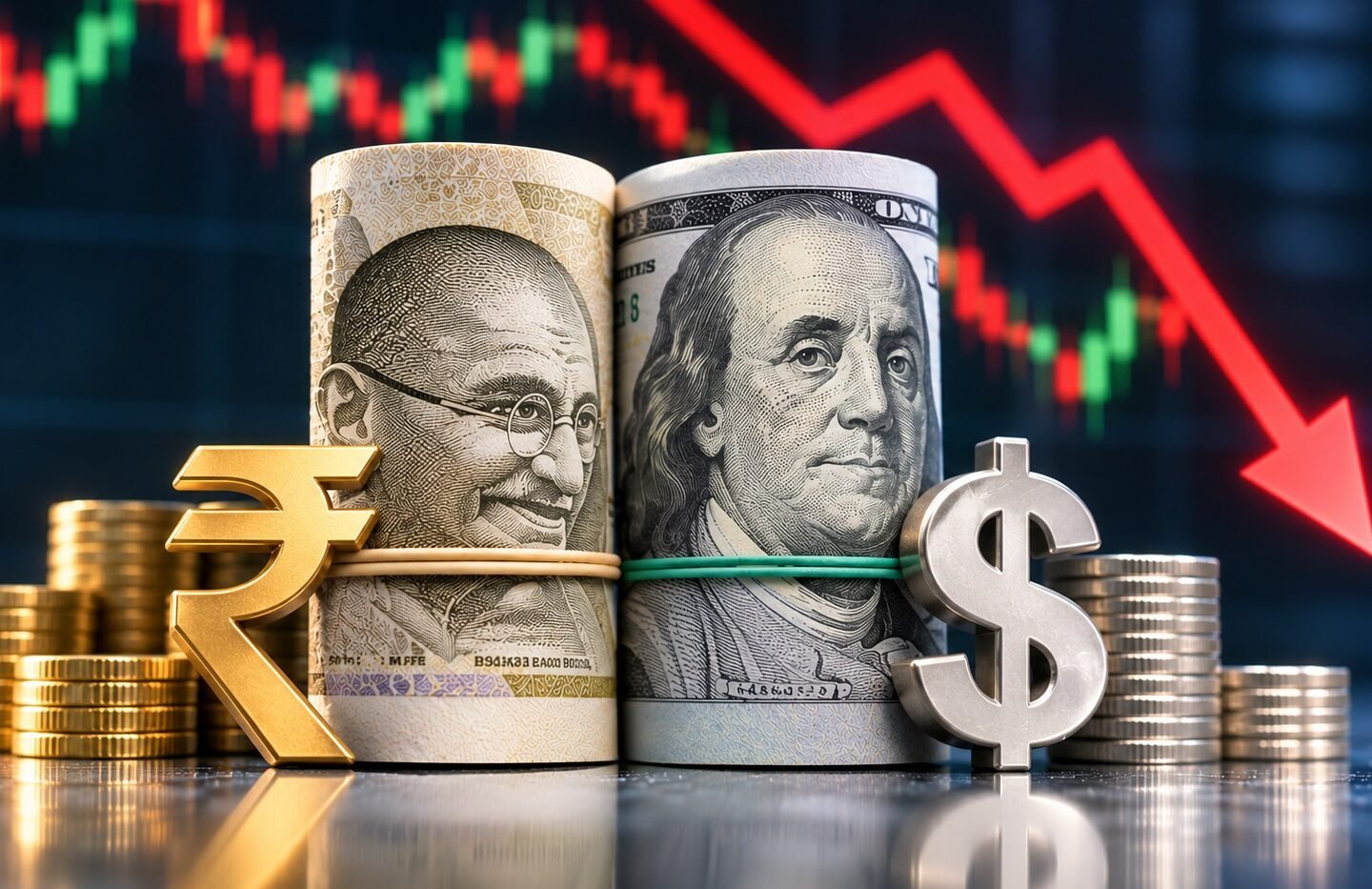



Rupee Declines in Early Currency Trade
The Indian rupee depreciated by 9 paise against the US dollar in early trading on Thursday, November 5, 2026, as pressure from the overseas currency market weighed on the domestic currency.
At the interbank foreign exchange market, the rupee opened at ₹94.36 per dollar before weakening to ₹94.55. This represented a decline of 9 paise from its previous closing level of ₹94.46.
The latest movement followed two consecutive sessions of gains. On Wednesday, the Indian currency had strengthened by 29 paise to settle at ₹94.46 against the greenback.
Forex market participants said positive sentiment in domestic equities and softer international crude oil prices helped restrict further losses.
Strong US Dollar Puts Pressure on the Rupee
The strength of the American currency in overseas markets remained an important factor influencing the rupee’s movement.
Changes in the US dollar’s value can affect emerging-market currencies because international investors and businesses use the dollar for trade, investment and financial transactions.
Although the US Dollar Index was trading around 101.22, down 0.34 per cent, currency traders continued to monitor broader dollar demand and global market developments.
Investors were also assessing the possible impact of the latest US midterm election results on geopolitical developments and international financial markets.
Crude Oil Prices Fall Below $100 Per Barrel
Declining crude oil prices provided some relief to the Indian economy and helped cushion the rupee’s weakness.
Brent crude, the global oil benchmark, was trading approximately 1.04 per cent lower at $93.64 per barrel in futures trade.
The benchmark had fallen more than 8 per cent in the previous session, dropping below the psychologically important $100 level.
The sharp decline followed changing expectations surrounding the US-Iran conflict after the US midterm election results. Market participants were increasingly hopeful that political developments could encourage diplomatic negotiations and reduce geopolitical risks to energy supplies.
Lower crude prices are particularly important for India because the country relies heavily on imported oil. A sustained decline in international energy prices can reduce import expenditure, ease pressure on the trade balance and support the domestic currency.
Sensex Surges Over 1,400 Points, Nifty Gains Nearly 379 Points
While the rupee weakened, Indian equity markets recorded strong gains during early trading on Thursday.
The BSE Sensex jumped 1,403.71 points to reach 78,689.87, while the NSE Nifty 50 advanced 378.85 points to 24,340.40.
The strong opening reflected improving investor sentiment following developments in global markets and the sharp correction in crude oil prices.
The rally in domestic equities also indicated renewed confidence among market participants, although the currency market continued to respond to separate global factors.
Foreign Institutional Investors Continue Buying Indian Shares
Foreign institutional investors (FIIs) remained net buyers in Indian equities on Wednesday, providing additional support to domestic market sentiment.
According to exchange data, foreign investors purchased shares worth ₹7,284.03 crore on a net basis during the session.
Continued foreign investment can support the rupee because overseas investors generally need Indian currency to purchase domestic assets.
However, equity inflows do not automatically translate into an immediate appreciation of the rupee. Currency movements also depend on import payments, dollar demand, global interest rates and other capital flows.
US Midterm Election Results Influence Global Market Sentiment
The latest US political developments have become an important factor for international markets.
The Democratic Party’s strong performance in the US midterm elections raised expectations that the administration could face greater legislative constraints on further military escalation involving Iran.
Market participants are assessing whether these developments could encourage diplomatic negotiations and reduce geopolitical uncertainty in West Asia.
A reduction in geopolitical tensions could help stabilise energy supplies and reduce the risk premium in international crude oil prices.
What Could Determine the Rupee’s Next Move?
The rupee’s direction in the coming trading sessions will depend on a combination of domestic and international developments.
Key factors to watch include:
- US dollar movement: Changes in global dollar demand could influence emerging-market currencies.
- Crude oil prices: Lower oil prices could reduce India’s import bill and provide currency support.
- Foreign investment flows: Continued FII buying may improve demand for Indian assets.
- Geopolitical developments: Changes in the US-Iran situation could influence global risk sentiment and energy markets.
- Domestic equity performance: Stronger investor confidence could encourage additional foreign investment.
The rupee’s latest decline highlights how currency markets can react differently from equity markets. Despite a strong rally in Indian shares and lower crude oil prices, overseas currency movements continued to put pressure on the domestic unit.