


AI Shopping Agents Are Changing Online Shopping
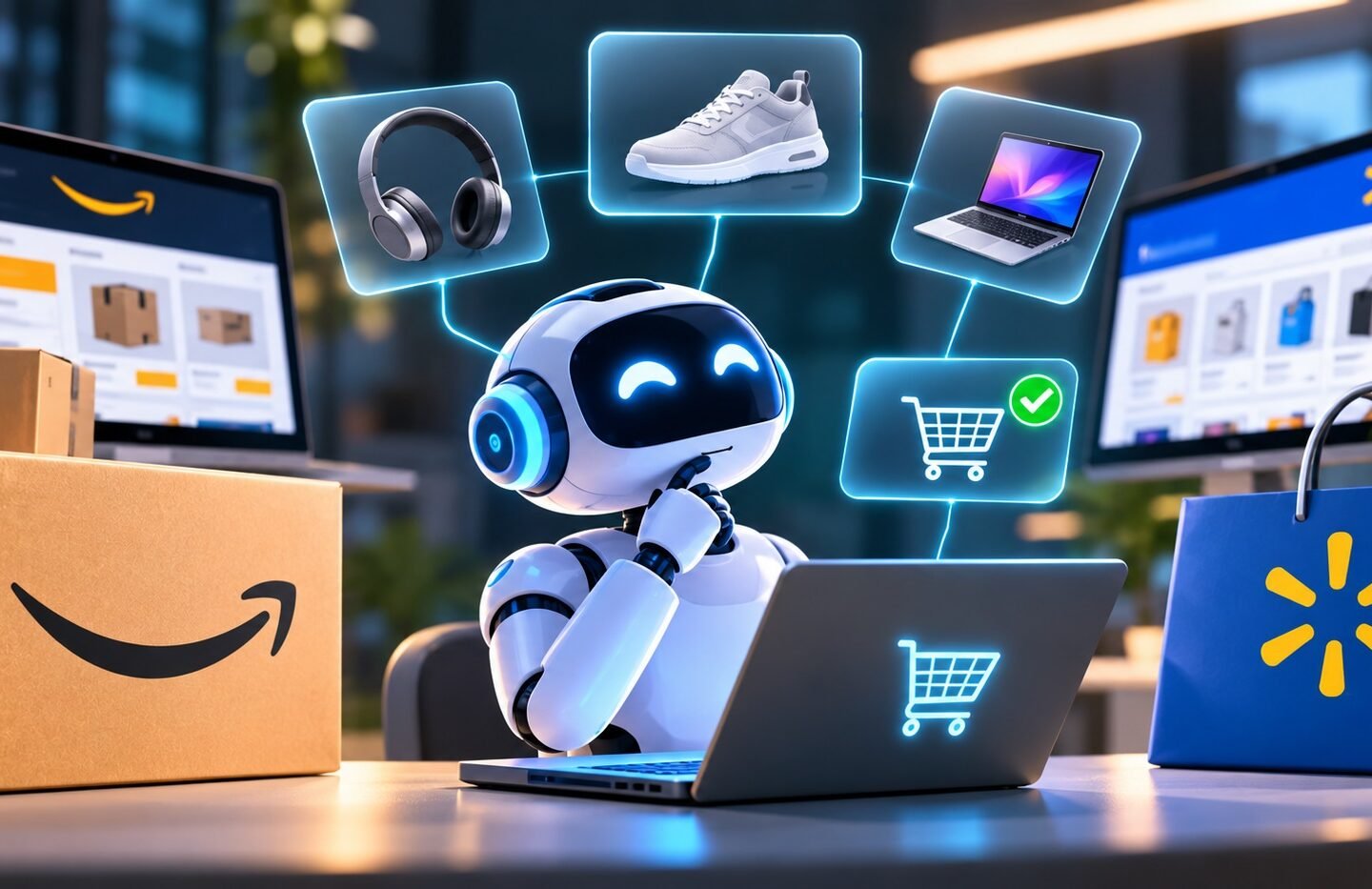
Artificial intelligence is entering a new phase of online shopping. Instead of browsing multiple websites, scrolling through product listings and comparing sponsored recommendations, consumers can increasingly ask AI shopping agents to find products, compare prices and complete purchases on their behalf.
This shift could create a major challenge for retail giants such as Amazon and Walmart, whose advertising businesses rely on shoppers visiting their websites and apps.
According to a Reuters report published on November 4, 2026, AI-powered shopping agents could disrupt the retail media industry by changing how consumers discover products and make purchasing decisions.
The concern is straightforward: if an AI agent handles the entire shopping process, consumers may never see the sponsored product listings and advertisements that generate substantial revenue for retailers.
Why Amazon and Walmart Have So Much at Stake
Amazon and Walmart dominate the US retail media advertising market, where brands pay retailers to promote products through sponsored listings, search results and other digital placements.
Together, the two companies account for approximately 88% of the estimated $74.4 billion US retail media market, according to eMarketer projections cited by Reuters.
For brands, advertising on retail platforms provides an opportunity to reach customers who are already considering a purchase. Retailers benefit from advertising revenue while gaining valuable information about customer preferences, searches and buying behaviour.
However, AI shopping agents could change this relationship.
When consumers ask an AI assistant to find the best smartphone, household appliance or grocery product, the agent may compare options across several retailers and recommend a product without requiring shoppers to visit those platforms directly.
This could reduce the number of opportunities retailers have to display advertisements and collect direct customer engagement data.
AI Agents Could Handle a Growing Share of E-Commerce
The potential scale of this change is significant.
Morgan Stanley researchers estimate that AI shopping agents could handle approximately 10% to 20% of US e-commerce spending by 2030.
These tools are designed to move beyond simple product recommendations. They can understand customer requirements, compare prices, evaluate product specifications and, where supported, complete transactions.
For example, a customer could ask an AI agent to:
- Find a laptop within a specified budget.
- Compare specifications, customer reviews and warranty terms.
- Identify the retailer offering the best overall deal.
- Check product availability and delivery options.
- Complete the purchase after receiving the customer’s approval.
If this experience becomes widely adopted, traditional product searches and sponsored listings could become less important in the shopping journey.
Amazon and Walmart Are Taking Different Approaches
The two retail giants are responding differently to the growing popularity of third-party AI shopping agents.
Amazon Protects Its Shopping Ecosystem
Amazon has taken a cautious approach towards external AI agents.
The company blocked Meta’s Muse shopping agent from accessing its platform, arguing that third-party agents must respect retailers’ decisions about participation and follow the required rules for accessing websites and customer accounts.
Amazon is also developing its own AI-powered shopping experience through Alexa for Shopping. The platform offers product comparisons, personalised recommendations, shopping assistance and sponsored conversational advertising.
Amazon’s strategy allows it to integrate AI into its existing shopping ecosystem while maintaining control over customer relationships and advertising opportunities.
The company has said that third-party AI agents have not yet had a material impact on its advertising business.
Walmart Opens Its Platform to AI Agents
Walmart is following a more open strategy.
On October 21, 2026, the retailer announced its Walmart Agent Gateway and Agent Profiles, designed to allow supported third-party AI assistants to connect with Walmart and Sam’s Club shopping systems.
Customers can authorise individual agents, monitor their purchases, establish spending limits and require approval before transactions are completed.
The system also allows shoppers to revoke an agent’s access.
Walmart’s approach could help the retailer reach customers through AI platforms rather than depending exclusively on visits to its own website and mobile application.
The difference between the two strategies highlights a major question for the industry: should retailers control the entire shopping experience, or should they allow external AI assistants to become another route to customers?
Retail Advertising Could Become More Conversational
AI shopping agents do not necessarily mean the end of digital advertising. Instead, they could change how brands pay to reach potential customers.
Traditional retail advertising focuses on sponsored search results, product placements, banners and recommendations.
In an AI-driven shopping environment, advertising could become more closely connected to conversations and customer requirements.
For example, when a consumer asks an AI assistant to recommend a washing machine, brands may compete to ensure their products appear in relevant recommendations.
Retailers are already experimenting with this model. Amazon has introduced sponsored advertising formats within Alexa for Shopping, while Walmart has been testing advertising within its Sparky AI shopping assistant.
This suggests that established retailers are attempting to adapt their advertising businesses rather than abandon them.
Brands Must Prepare for AI-Driven Product Discovery
The growth of AI shopping agents could also change how brands approach digital marketing.
Companies may need to ensure that their product information is accurate, detailed and structured in a way that AI systems can understand.
Important information could include:
- Product specifications and technical details.
- Current prices and available discounts.
- Inventory and delivery information.
- Customer reviews and product ratings.
- Warranty, return and support policies.
- Clear product descriptions and comparisons.
Brands that provide reliable product information may have a better chance of being considered by AI assistants.
Companies such as Procter & Gamble, Nestlé and L’Oréal are among those exploring ways to make product information more accessible to AI-powered discovery systems.
This could create a new form of competition in which brands optimise not only for traditional search engines and retail marketplaces but also for AI recommendations.
Why the Threat Is Not Immediate
Despite the potential disruption, AI shopping agents are still at an early stage of adoption.
Many consumers remain cautious about allowing software to make purchasing decisions or handle transactions on their behalf.
Trust, product recommendation transparency, payment security and the accuracy of AI-generated information remain important challenges.
Retail media advertising is also expected to continue growing. eMarketer forecasts that US retail media spending will increase by 22.6% in 2026 compared with the previous year.
Industry analysts therefore see AI shopping as an evolution of retail advertising rather than an immediate threat to its existence.
Retailers are likely to experiment with new advertising formats, partnerships and AI-powered shopping experiences as consumer behaviour changes.
The Future of E-Commerce Could Be Controlled by AI Recommendations
The competition between Amazon, Walmart and technology companies is entering a new phase.
For years, online retailers competed to attract customers through search rankings, product recommendations, sponsored listings and personalised advertising.
AI shopping agents could shift some of that influence from retailers to independent digital assistants that make purchasing decisions on behalf of consumers.
The companies that successfully adapt may find new opportunities to reach customers through conversational commerce and AI-driven product discovery.
For Amazon and Walmart, the challenge will be to embrace AI-powered shopping without weakening the advertising businesses and customer relationships that have made their platforms so valuable.