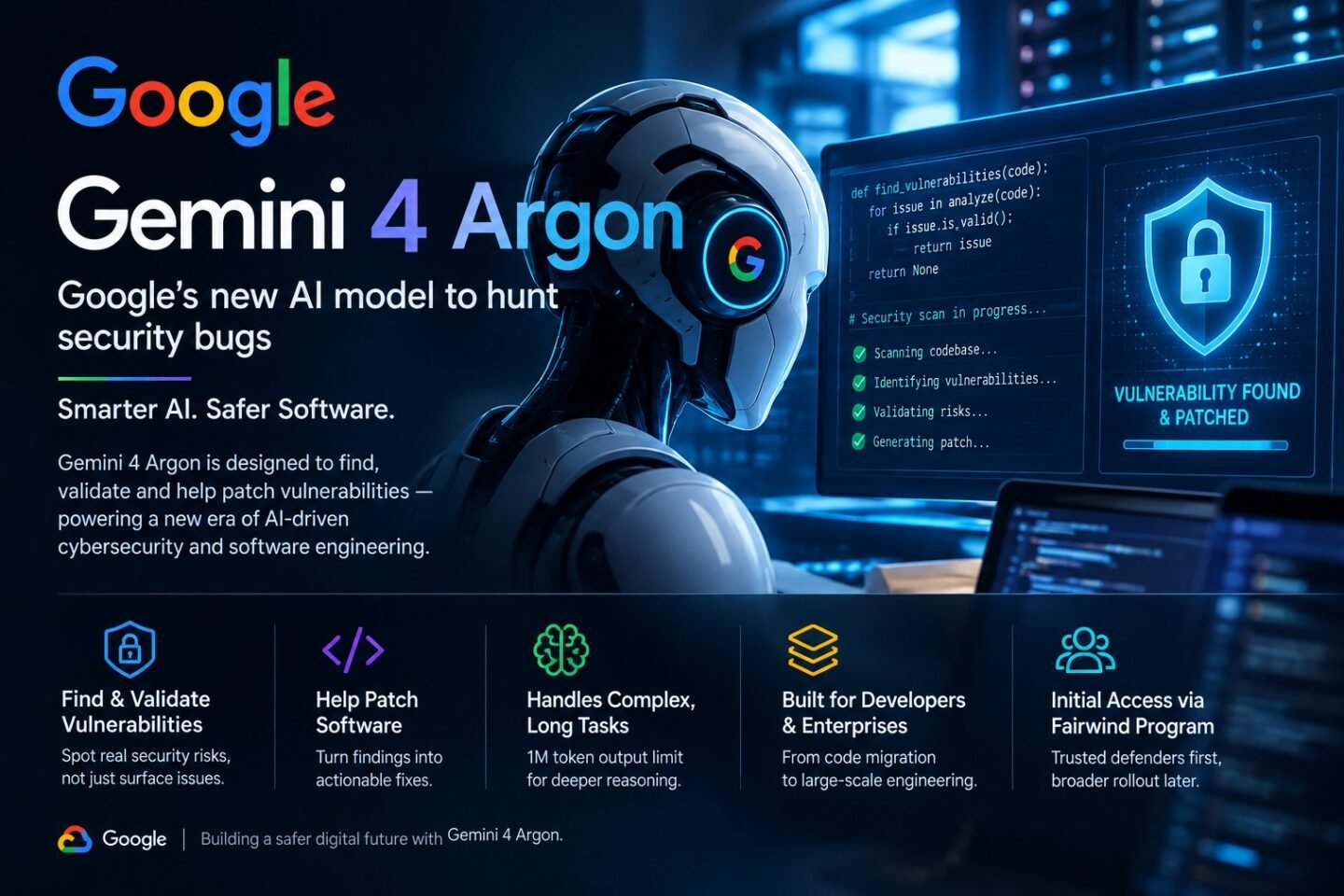



Google has introduced Gemini 4 Argon, a new frontier AI model designed to handle complex, long-running tasks across software engineering, enterprise work, and cybersecurity.
Unlike a conventional chatbot that primarily responds to individual prompts, Google says Argon is designed to sustain reasoning across lengthy workflows. One of its most notable applications is cybersecurity, where Google says the model can identify, validate, and help patch software vulnerabilities.
The model is initially being made available to a limited group of trusted cyber defenders through Google’s Fairwind Program, rather than being immediately opened to the general public.
What Is Gemini 4 Argon?
Gemini 4 Argon is Google’s latest frontier model in the Gemini family. Google describes it as a system built for difficult, multi-step workflows requiring sustained reasoning, coding, research, and multimodal understanding.
One of its defining technical features is a 1-million-token output limit, substantially larger than the previous 64,000-token limit cited by Google. The company says this allows Argon to work through extremely long tasks and produce much larger reasoning trajectories in a single run.
Google says Argon is already being used internally for tasks ranging from debugging and software engineering to large-scale codebase migration and research.
Why Is Gemini 4 Argon Important for Cybersecurity?
The cybersecurity capabilities are among the most significant parts of Google’s announcement.
Google says Argon has been trained to support defensive security work, including finding vulnerabilities, validating potential weaknesses, and producing patches. The goal is to help security teams identify software problems before they can become serious risks.
According to Google, Argon tied for first place on CWE-bench v1, a benchmark focused on vulnerability remediation, with a score of 68%. Google also reports stronger vulnerability-discovery performance than its earlier Gemini 3.8 Flash Cyber model on several internal evaluations.
These figures are Google-reported benchmark results, so they should be understood in the context of the company’s own testing methodology rather than as an independent industry-wide ranking.
From Finding Bugs to Helping Fix Them
Traditional software security involves multiple stages. Security researchers and engineers need to identify a potential vulnerability, understand its cause, determine its impact, develop a fix, test that fix, and then deploy it safely.
AI could potentially accelerate parts of this process.
Google says Argon can work across several of these stages, allowing defenders to move from vulnerability discovery toward validation and remediation more quickly.
That distinction is important. The broader value of cybersecurity AI is not simply finding more bugs; it is helping organizations turn those discoveries into verified fixes without introducing new problems.
Google Is Already Using Argon Internally
Google says Gemini 4 Argon is already being used in internal workflows by thousands of employees.
One example involves large-scale code migration. According to Google, Argon agents are helping migrate C and C++ codebases to Rust, including projects ranging from tens of thousands of lines to more than 800,000 lines of code.
Google also says Argon helped optimize memory usage across its data centers, with more than 300 TiB of memory freed after the changes were rolled out.
These applications highlight Google’s broader vision: AI agents that can participate in substantial engineering projects rather than simply generating isolated pieces of code.
A Major Focus on Long-Horizon Tasks
One of Argon’s biggest differences is its emphasis on long-horizon work.
Many AI systems are effective at completing relatively contained tasks. More complicated professional workflows, however, can require hundreds of individual steps and sustained context.
Google says the expanded 1-million-token output capacity is intended to give Argon more room for these tasks.
This could be particularly useful in software engineering, where understanding a large codebase may require examining relationships between numerous files, functions, dependencies, tests, and documentation.
Security Is Also a Challenge for AI
The same capabilities that make advanced AI useful for cybersecurity can create new safety concerns.
A highly capable model that can identify vulnerabilities could potentially be misused if its capabilities were broadly available without appropriate controls.
Google says it is therefore taking a phased approach to Argon’s release.
The company says it is strengthening safeguards against harmful cybersecurity and other high-risk misuse, while also working on protections against indirect prompt-injection attacks and potential model misalignment.
Google also says Argon’s reasoning and actions can be monitored, with systems designed to stop execution when necessary.
What Is the Fairwind Program?
Gemini 4 Argon is initially being distributed through Google’s Fairwind Program, a limited-access initiative for trusted cybersecurity defenders.
Google launched Fairwind in September 2026 as a way to give selected governments, enterprises, and cybersecurity partners access to advanced AI-powered defensive capabilities. Earlier Fairwind offerings included Gemini 3.8 Flash Cyber combined with Google’s CodeMender system.
For Argon, Google says the initial group of trusted defenders will help provide real-world feedback before the model becomes more widely available.
Argon and the Future of AI-Powered Security
Gemini 4 Argon arrives at a time when AI is becoming increasingly involved in software security.
Google has already been using AI-assisted vulnerability research in projects such as its Chrome security work. In July 2026, Google described using Gemini-based systems to improve vulnerability discovery and automated security workflows within controlled environments.
Argon represents an extension of that direction: moving from AI-assisted analysis toward systems capable of handling larger portions of the security workflow.
The larger question is how much of software security can eventually be automated while keeping human oversight, testing, and accountability firmly in place.
How Much Does Gemini 4 Argon Cost?
Google says Argon will initially launch at $2 per million input tokens and $10 per million output tokens.
After the introductory period, Google says pricing will increase to $4 per million input tokens and $20 per million output tokens. Cached input tokens receive a substantial discount under Google’s announced pricing structure.
Broader availability is expected to begin with paid API customers and Google AI Ultra subscribers, according to Google.
When Will Gemini 4 Argon Be Available?
For now, Argon is being rolled out to a limited group of trusted cyber defenders.
Google says the company is participating in the U.S. government’s voluntary pre-release model access process while continuing to strengthen its safeguards. The company plans to expand availability to developers, enterprises, and consumers after further testing and iteration.
That staged rollout reflects the unusual nature of the model: Google is not treating its cybersecurity capabilities as just another feature in a consumer chatbot.
What Gemini 4 Argon Could Mean for Software Security
The arrival of Gemini 4 Argon points toward a broader change in how software security may be approached.
Instead of relying exclusively on humans to manually inspect enormous codebases, organizations could increasingly use AI systems to continuously analyze software, identify potential weaknesses, validate findings, and assist with remediation.
That does not eliminate the need for security engineers. In fact, highly capable AI may make human review even more important as organizations manage increasingly autonomous systems.
The real test for Gemini 4 Argon will therefore extend beyond benchmark scores. Its long-term impact will depend on how accurately it discovers real vulnerabilities, how reliably its proposed fixes work, how safely organizations can deploy it, and how effectively humans can supervise increasingly capable AI agents.