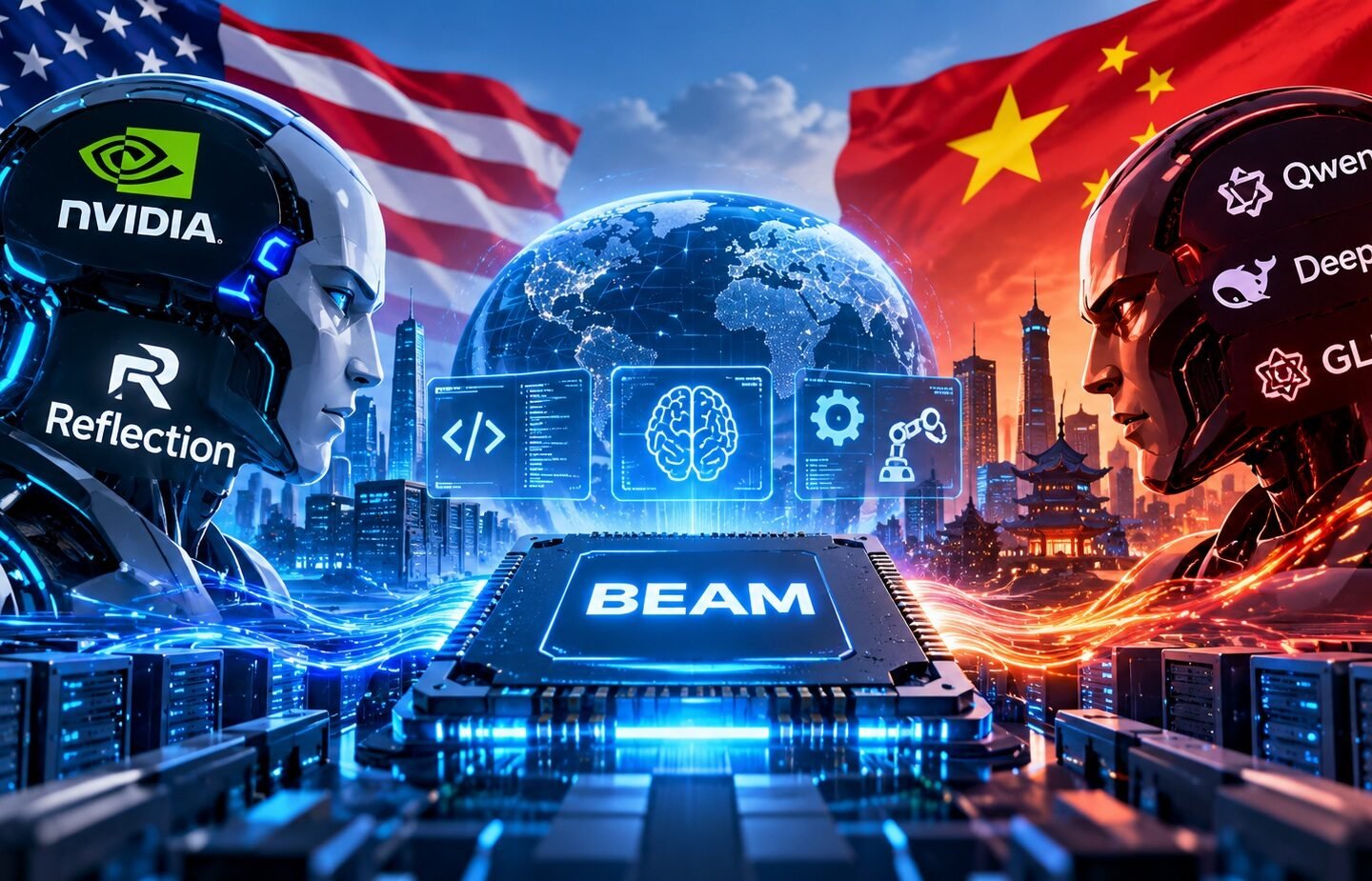



The global race for powerful and affordable artificial intelligence is entering a new phase as Reflection AI, a U.S.-based startup backed by Nvidia, has unveiled its first open-weight AI model, Beam.
The company is positioning Beam as a Western alternative to leading Chinese open models, including Z.ai’s GLM-5.2, Qwen and DeepSeek, with a particular focus on coding, reasoning and AI agents.
Beam Targets Coding and AI Agent Tasks
Reflection says Beam was designed as a “workhorse” model for developers, businesses and government organizations.
The model uses a Mixture-of-Experts (MoE) architecture with approximately 501 billion total parameters, while only around 23 billion parameters are activated for an individual task. This approach is designed to provide strong capabilities without requiring the full model to run for every request.
Reflection has placed particular emphasis on software development and agentic workloads, where AI systems can perform multi-step tasks rather than simply respond to individual prompts.
Lower Computing Costs Could Be Beam’s Biggest Advantage
Performance is only one part of the competition. The cost of running advanced AI models has become increasingly important for businesses and governments.
Reflection claims Beam can deliver performance comparable to GLM-5.2 on advanced reasoning benchmarks while requiring three to four times less inference compute. The company says Beam is also approaching the performance of larger models such as Qwen 3.8-Max on coding and agentic tasks.
These figures come from Reflection’s own evaluations and have not yet been independently verified across all benchmarks.
A Major Push Into Open-Weight AI
Unlike closed AI systems that are primarily accessed through APIs, open-weight models can be downloaded, customized and deployed by organizations on their own infrastructure.
That flexibility is increasingly attractive to companies that want greater control over sensitive data, operating costs and model customization.
Chinese companies have become major players in this market, with models from DeepSeek, Qwen, Kimi and Z.ai gaining significant attention. Reflection’s Beam represents an attempt to strengthen the Western open-model ecosystem and provide organizations with another option.
Massive Computing Investment Behind Beam
Building frontier AI models requires enormous computing resources. Reflection has invested heavily in securing access to advanced Nvidia hardware.
The company says its Beam reinforcement-learning training involved more than 100 million rollouts across 10,500 Nvidia GB300 GPUs over four weeks. Reflection also previously secured major computing agreements involving SpaceX and Nebius.
The close relationship with Nvidia is strategically significant because Nvidia benefits from the growing demand for AI computing infrastructure while Reflection gets access to the hardware required to develop increasingly powerful models.
Reflection’s Bigger Vision: AI Factories
Beam is only part of Reflection’s broader strategy.
The startup wants businesses and governments to build customized AI systems using their own data and computing infrastructure. Reflection describes this concept as an “AI factory”, where organizations can create localized AI systems tailored to their specific requirements.
Such systems could be particularly attractive to governments, financial institutions, large enterprises and organizations that cannot or do not want to rely on foreign AI platforms.
The U.S.-China Open AI Race Intensifies
The launch of Beam comes at a time when Chinese open-weight models have become increasingly competitive in areas that were previously dominated by U.S. AI companies.
Reflection’s entry adds another serious Western contender to the market alongside models from Nvidia, Meta, Mistral and other companies.
The company has also been building relationships with government and enterprise customers, reflecting a growing interest in AI systems that organizations can operate and customize themselves.
What’s Next for Beam?
Reflection says Beam is undergoing final safety testing and evaluation. The company plans to release the model’s weights, technical report, model card and developer resources later in October 2026.
The startup is already working on a larger model that it says will be significantly more powerful than Beam.