


OpenAI has opened up a remarkable collection of mathematical research produced by one of its unreleased frontier AI models, giving researchers a rare look at how advanced AI systems are beginning to contribute to original mathematical research.
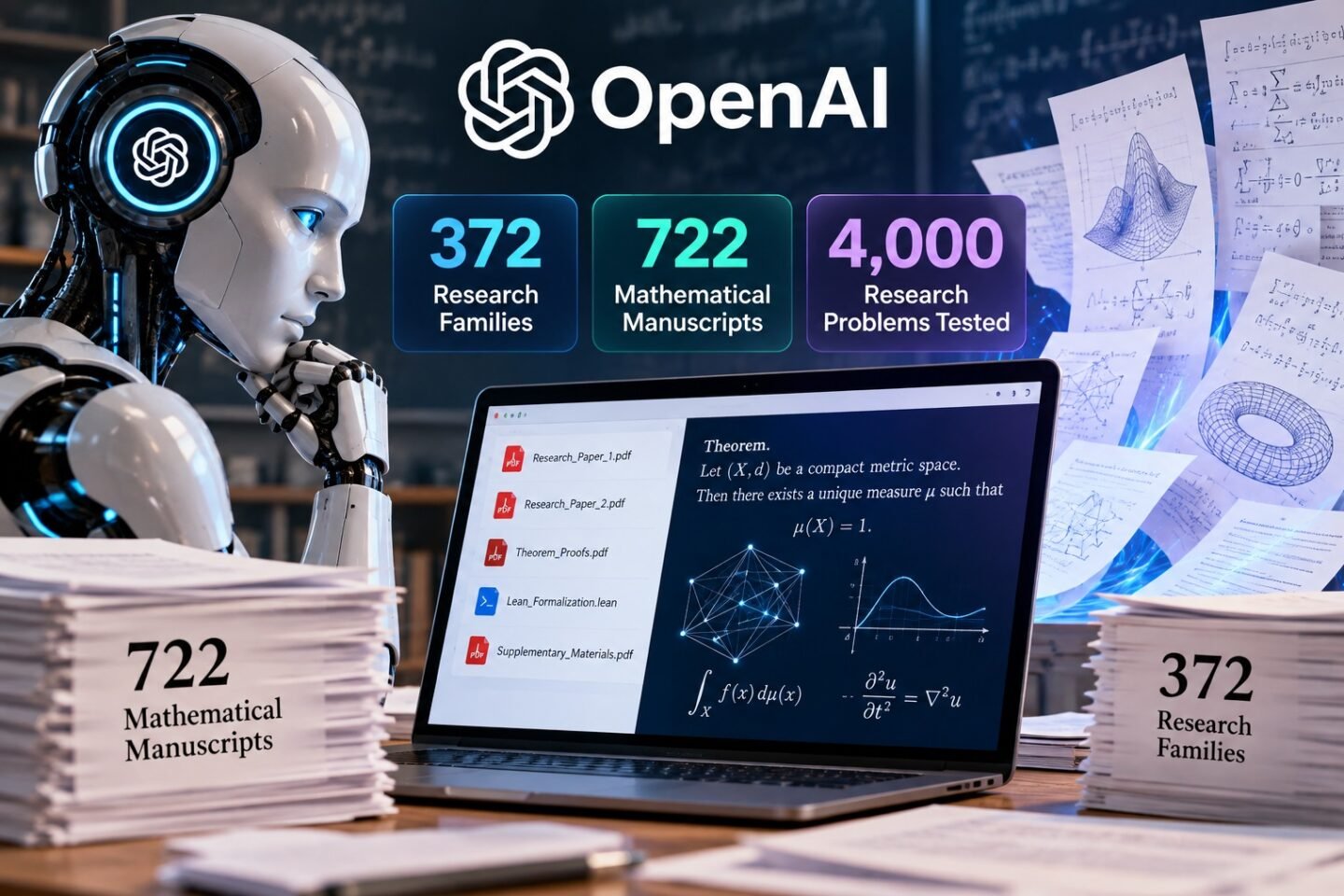
The company has released 722 mathematical manuscripts organized into 372 research families, generated largely through work by an internal frontier model that has not yet been publicly released. The results cover a broad range of mathematical disciplines and include research papers, proof artifacts and computer-checkable formalizations.
A Large-Scale AI Mathematics Release
The release represents one of the most significant public disclosures of AI-generated mathematical research so far.
According to information accompanying the collection, OpenAI tested its internal model on approximately 4,000 research problems. The resulting work was then filtered and organized into mathematical families. A family can contain a primary result along with related papers, alternative proofs, consequences or companion arguments.
Rather than simply publishing a list of AI-generated answers, OpenAI has provided researchers with supporting materials intended to make the results easier to investigate and verify.
The collection includes PDFs, source files, citation information and, for many results, Lean formalizations that allow mathematical proofs to be checked computationally.
The AI Model Has Not Been Released
One of the most interesting aspects of the announcement is that the model responsible for the research remains private.
OpenAI has not publicly identified the frontier model used to generate the majority of these results. The company says it is working toward responsibly releasing the model that produced them.
This means researchers can examine the mathematical output without yet having direct access to the underlying AI system.
That approach could provide an important test of whether frontier AI models can generate useful scientific knowledge independently of conventional benchmark scores.
From 4,000 Problems to 372 Research Families
OpenAI says the model was presented with roughly 4,000 mathematical research problems during the evaluation process.
Only a portion of the resulting work made it into the public collection. The published catalogue currently contains 722 manuscripts grouped into 372 families.
This distinction is important.
The 372 families should not be interpreted as 372 completely independent breakthroughs. Some families contain multiple related manuscripts addressing the same underlying mathematical question.
Nevertheless, the scale of the collection is significant because it demonstrates an AI system producing research across many different areas of mathematics rather than solving a narrow benchmark.
Lean Proofs Could Make the Results Easier to Verify
A major component of the release is its use of Lean, a formal proof system that allows mathematical arguments to be checked by computer.
Not every manuscript currently has a Lean formalization, and OpenAI itself warns that some unformalized results could contain problems. However, formalized results offer researchers a stronger way to validate whether the underlying proof is logically correct.
This could become increasingly important as AI systems generate mathematical research at a scale that would be difficult for humans to manually evaluate.
Instead of asking researchers to immediately inspect every line of a lengthy AI-generated proof, formal verification can provide an additional layer of computational checking.
How Much Computing Did the Research Require?
OpenAI has also provided unusual details about the amount of computation involved.
The company reports that the average published result used computational resources roughly equivalent to three hours of ChatGPT Pro-level thinking. It has also released additional information about the number of attempted problems and selected summaries of the model’s reasoning.
That information could help researchers understand the economics of AI-assisted mathematical discovery.
If increasingly capable models can generate meaningful mathematical results using manageable amounts of computation, AI could become a practical research tool for mathematicians, universities and scientific organizations.
Not Every Result Is Automatically a Breakthrough
The sheer number of manuscripts should not be mistaken for hundreds of independently verified breakthroughs.
The collection is still at different stages of verification, and OpenAI acknowledges that some results require additional mathematical scrutiny.
This distinction matters because mathematical research depends on rigorous verification. An AI system can produce an apparently convincing argument that nevertheless contains a subtle error.
Human mathematicians therefore remain essential for evaluating significance, checking assumptions, understanding implications and determining whether a result genuinely advances a field.
Why This Matters for AI Research
The announcement points toward a potentially important change in the way frontier AI systems are evaluated.
For years, AI progress has largely been measured through benchmarks involving mathematics, coding, language and reasoning. OpenAI’s latest release shifts attention toward a different question:
Can AI systems produce new knowledge rather than simply reproduce or solve known problems?
If even a fraction of the published results survive independent scrutiny and prove valuable to researchers, it could represent an important step toward AI-assisted scientific discovery.
Mathematics is particularly significant because successful research requires more than calculating an answer. It often involves discovering useful conjectures, finding unexpected connections and constructing rigorous proofs.
A New Role for AI in Mathematics
The release also highlights an emerging model of collaboration between AI systems and human researchers.
AI can potentially explore thousands of ideas, test approaches and identify patterns at a speed that would be difficult for an individual mathematician to match. Human researchers can then focus on verification, interpretation and determining which discoveries matter most.
OpenAI’s collection provides an unusually large dataset for studying that relationship.
Rather than presenting AI as a replacement for mathematicians, the results suggest a future in which advanced models become research assistants capable of exploring mathematical territory at unprecedented scale.
The Bigger Picture
OpenAI’s 372 mathematical research families are significant not simply because of their size, but because they offer a glimpse into what frontier AI could mean for scientific research.
The model behind the work remains unreleased, and many of the results still require independent verification. But publishing the underlying manuscripts and proof artifacts gives the wider mathematical community an opportunity to examine the claims for itself.
If researchers validate a meaningful number of these results, the release could become an important milestone in the development of AI-powered mathematics and automated scientific discovery.
The bigger question is no longer only whether AI can solve difficult mathematical problems.
It is whether AI can become a reliable partner in creating new mathematics.
For now, the mathematical community has hundreds of new results to investigate—and potentially a new chapter in AI-assisted research to write.