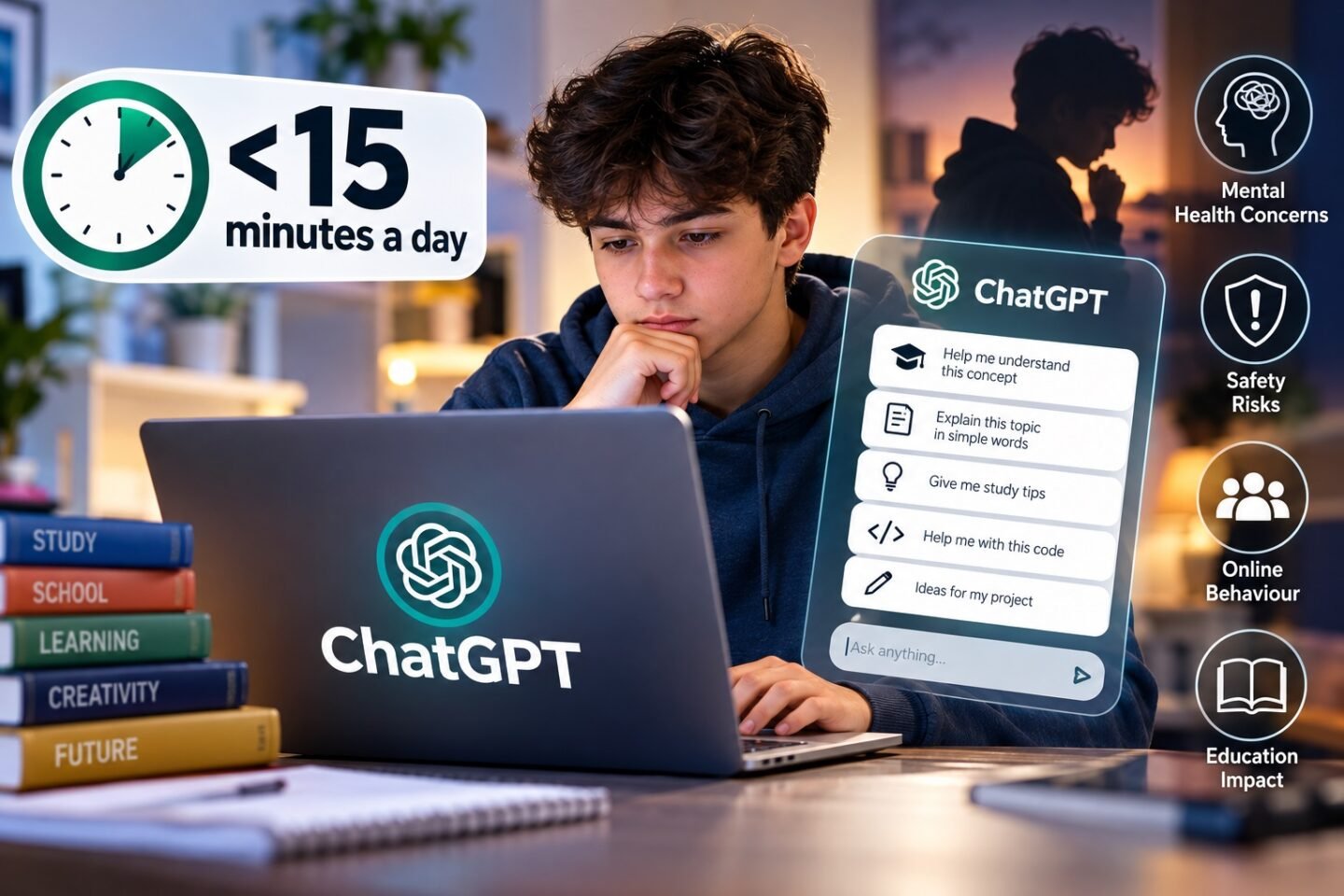



OpenAI has released its first detailed look at how teenagers are using ChatGPT, reporting that teens spend less than 15 minutes per day on the platform on average. The company also said that fewer than 2% of teen users spend more than three consecutive hours chatting with the AI.
The figures come at a time when AI companies are facing increasing scrutiny over the potential effects of chatbots on young people’s mental health, education and online behaviour.
Teen Use of ChatGPT Remains Relatively Limited
According to OpenAI’s latest data, the average teen session time is considerably lower than some concerns about excessive AI engagement might suggest.
The company said that among conversations where its break reminder appeared, nearly half of teens either took a break or ended the conversation within five minutes. OpenAI is presenting this as evidence that interventions designed to encourage healthier usage can influence behaviour.
However, usage duration alone does not answer the larger question of whether AI is safe for younger users.
Safety Concerns Continue to Grow
The new data was released on the same day that Common Sense Media’s Youth AI Safety Institute published a critical assessment of ChatGPT for Teens.
The organisation said it tested more than 4,000 prompts and rated the product an “Unacceptable Risk” for users under 18. It raised particular concerns about safeguards involving self-harm, eating disorders and other sensitive topics.
OpenAI disputes the assessment, arguing that the testing methodology did not accurately reflect how its teen safeguards work in real-world conditions. The company said that parental controls and safety systems can require time to become fully active after accounts are linked.
OpenAI Is Building a Separate Teen Experience
OpenAI launched ChatGPT for Teens in August 2026 with additional protections designed specifically for users under 18.
The experience includes age-appropriate safeguards, Study Mode, homework guidance, break reminders and optional parental controls. OpenAI says the system is designed to encourage learning while maintaining real-world relationships and healthy technology habits.
The company has also been expanding educational features. These include learning visualizations, Study Mode and upcoming tools intended to help students with studying and college planning.
Education Is Becoming a Major Focus
Rather than positioning ChatGPT for Teens simply as a general-purpose chatbot, OpenAI is increasingly emphasizing education.
Study Mode is designed to guide students through problems rather than simply providing an answer. OpenAI says the goal is to help teenagers understand concepts, practice skills and develop independent problem-solving abilities.
This approach could make AI useful as an educational assistant, but it also raises questions about academic integrity and whether students can bypass learning by relying too heavily on automated answers.
The Bigger Question Is Not Just Screen Time
The “under 15 minutes” figure provides useful context, but it should not be treated as proof that AI-related risks are insignificant.
A teenager could spend only a short amount of time with an AI system and still encounter harmful or inappropriate content. Conversely, longer usage does not automatically mean harmful usage.
The more important questions are what teenagers are asking AI, how the system responds, whether appropriate safeguards activate and whether AI encourages healthy relationships with parents, teachers and peers.
That distinction is becoming increasingly important as chatbots become more capable and more deeply integrated into education and everyday life.
A New Test for AI Companies
OpenAI’s latest data highlights a difficult balancing act for the AI industry.
Companies want young people to benefit from AI’s educational potential while preventing excessive dependence and reducing exposure to harmful content. OpenAI says its teen-focused safeguards are designed around that balance, while independent groups argue that stronger protections and greater transparency are still needed. The debate is therefore moving beyond the question of “How much time are teenagers spending with AI?”
The bigger question is becoming “What kind of relationship should teenagers have with AI?”
As AI becomes a regular part of education, communication and creative work, the answer could shape how the next generation learns to use these technologies.