


Introduction
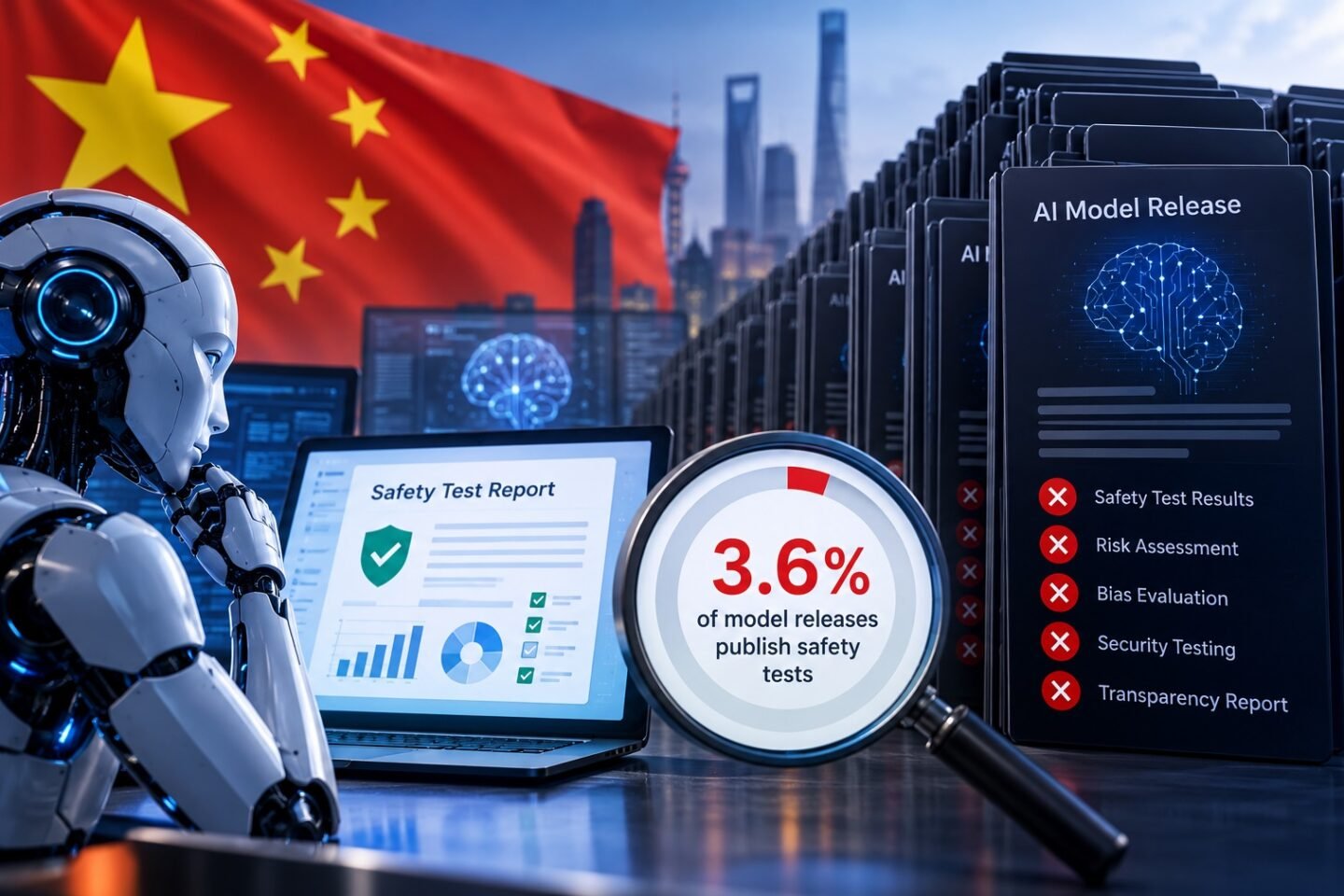
China’s rapidly expanding artificial intelligence industry is facing renewed questions about safety, transparency, and accountability after a report found that developers publish safety test results for only 3.6% of their AI model releases. The findings highlight a potential gap between the rapid development of advanced AI systems and the public disclosure of information needed to evaluate their risks.
As AI adoption accelerates across industries, safety testing and transparent reporting are becoming increasingly important. Researchers, businesses, policymakers, and users need reliable information to understand how AI systems behave, where they may fail, and whether adequate safeguards are in place.
A Major Gap in AI Safety Reporting
AI safety testing helps identify potential problems before models are widely deployed. These assessments may examine harmful outputs, cybersecurity vulnerabilities, privacy risks, misinformation, bias, and the possibility of models being misused.
However, when developers do not publish their testing results, independent researchers and the public have fewer opportunities to evaluate whether these systems meet appropriate safety standards.
The reported figure of 3.6% suggests that publicly available safety test results remain uncommon among the model releases covered by the study. It does not necessarily mean that the remaining models were never tested internally. Instead, it highlights a lack of publicly disclosed evidence that would allow outsiders to assess their safety.
This distinction is important because internal testing and public transparency serve different purposes. Internal evaluations help developers identify and address problems, while external disclosure allows independent experts to examine the methodology, challenge assumptions, and identify potential weaknesses.
Why AI Safety Transparency Matters
AI systems are increasingly used in customer service, software development, healthcare support, education, finance, and business automation. As their capabilities expand, failures can have consequences beyond individual users.
Publishing safety evaluations can help stakeholders understand several critical areas:
- Reliability: Whether a model produces consistent and accurate responses.
- Cybersecurity: Whether it can assist malicious activity or expose sensitive information.
- Privacy protection: Whether it improperly reveals confidential or personal data.
- Bias and fairness: Whether its outputs disadvantage particular groups.
- Misuse prevention: Whether safeguards can reduce harmful or dangerous applications.
Transparent testing does not guarantee that an AI model is safe. Nevertheless, it provides a foundation for independent scrutiny and more informed decisions about deployment.
China’s Competitive AI Landscape
China has become an important centre of AI research and development, with domestic companies competing to build advanced language models, coding assistants, image-generation systems, and enterprise AI platforms.
Competition encourages innovation, but it can also create pressure to release models quickly. When companies prioritise development speed and market position, comprehensive documentation and public safety reporting may receive less attention.
The challenge is not limited to China. AI developers around the world face questions about how much information to disclose, how to protect proprietary technology, and how to demonstrate that their products have been adequately evaluated.
The reported findings therefore raise a broader industry question: how can AI companies maintain their competitive advantage while providing enough evidence for users and independent experts to assess safety?
The Role of Governments and Regulators
Governments and regulatory bodies can influence AI safety practices by establishing clearer expectations for risk assessment, documentation, and disclosure.
Possible measures include standardised safety evaluation frameworks, independent audits for high-risk models, incident-reporting requirements, and public documentation of important test results.
A consistent reporting framework could make it easier to compare models from different developers. It could also help businesses choose AI systems based on documented safety performance rather than relying exclusively on marketing claims or benchmark scores.
At the same time, disclosure requirements need to be designed carefully. Publishing sensitive security details could potentially help malicious actors exploit vulnerabilities. Effective policies should encourage meaningful transparency without exposing information that could increase security risks.
What This Means for Businesses and AI Users
For organisations adopting AI tools, the findings reinforce the importance of due diligence. Businesses should not evaluate AI products solely on their speed, cost, or performance.
Before deploying an AI system, organisations should consider whether the provider publishes safety documentation, explains known limitations, supports independent evaluation, and provides a clear process for reporting incidents.
Companies using AI for sensitive operations should also conduct their own testing, restrict access to confidential information, and maintain human oversight where errors could cause significant harm.
For developers, publishing clear model cards, evaluation methodologies, known limitations, and safety findings can strengthen trust and demonstrate a commitment to responsible innovation.
The Road Ahead
The future of artificial intelligence will depend not only on how powerful models become, but also on how responsibly they are developed and deployed.
The reported 3.6% publication rate highlights a transparency challenge that deserves attention from AI companies, researchers, businesses, and policymakers. Improving disclosure practices could help build confidence in emerging technologies while making it easier to identify weaknesses before they cause harm.
Ultimately, AI safety should be treated as an essential part of development rather than an optional step after a product is released. Greater transparency, independent assessments, and consistent reporting standards can help the industry pursue innovation without overlooking accountability.