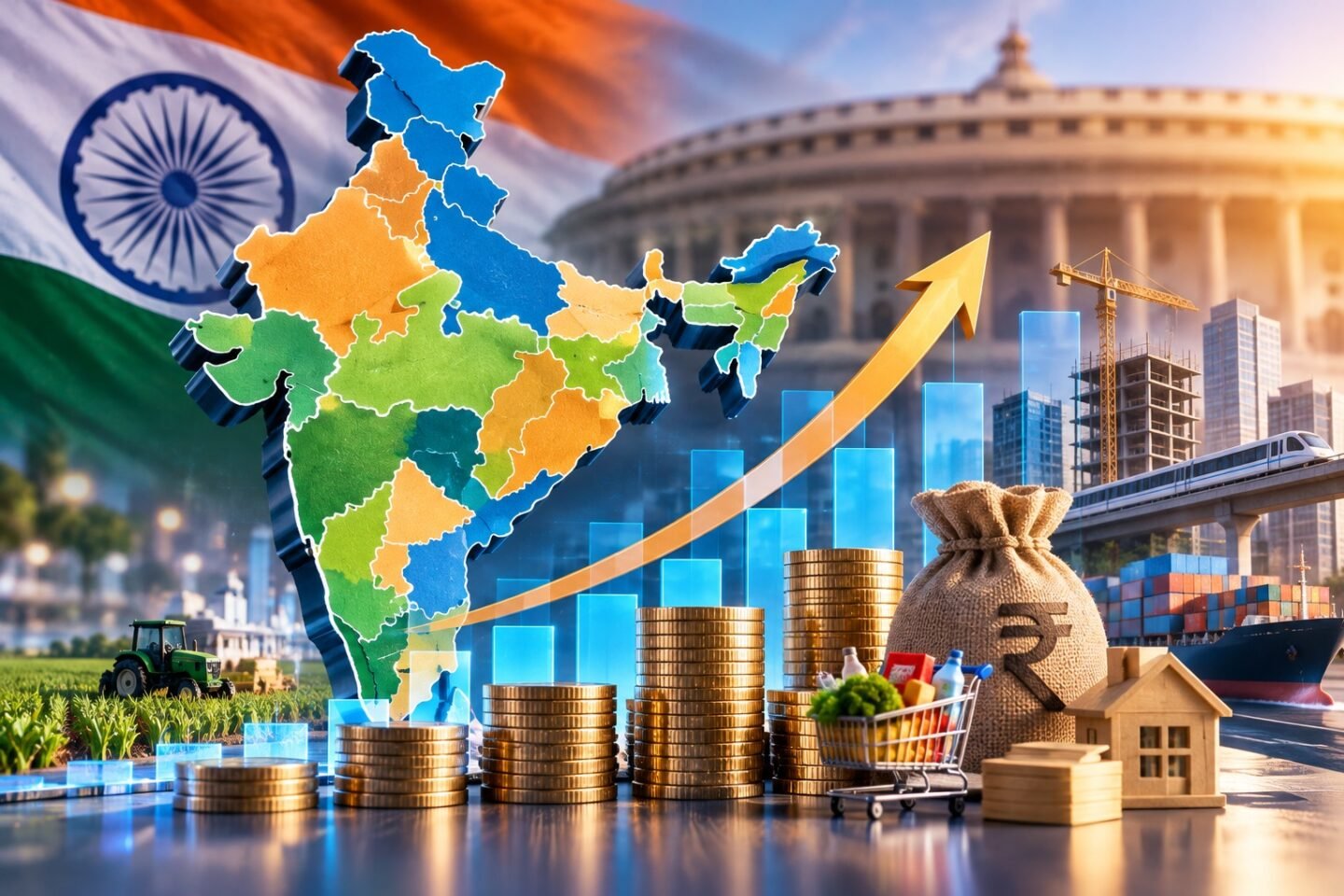


India is taking an important step toward improving the way economic growth is measured across its states and Union Territories. The Ministry of Statistics and Programme Implementation (MoSPI) has released draft guidelines for calculating Gross State Domestic Product (GSDP) using the expenditure approach, offering a new way to understand how money moves through regional economies.
The proposed framework, based on the revised 2022–23 base year, aims to standardize state-level economic estimates and make comparisons between regions more consistent. It will complement existing methods that primarily measure economic activity through production and income.
What Is the New Spending-Based GDP Method?
Traditionally, state economic performance has been assessed mainly by examining the value of goods and services produced within a state’s borders. The expenditure approach looks at the same economy from another perspective: how much is spent on final goods and services.
This method helps policymakers understand the contribution of household consumption, government spending, business investment, and other expenditure components to economic activity.
The standard GDP expenditure formula is:
GDP = C + I + G + (X − M)
Where:
- C — Consumption: Spending by households on goods and services.
- I — Investment: Spending on buildings, machinery, equipment, and other capital assets.
- G — Government spending: Expenditure on public services and government consumption.
- X − M — Net exports: Exports minus imports.
For state-level estimates, the proposed framework also addresses changes in inventories and valuables, alongside the major expenditure categories.
Why Is India Introducing This Framework?
One of the key objectives is to address gaps in state-level economic statistics. Although some states already estimate government consumption and fixed capital formation, private final consumption expenditure has not been compiled by any state or Union Territory.
Household spending represents a major part of economic activity. Without a systematic estimate of this component, it becomes more difficult to develop a comprehensive picture of consumption patterns and regional demand.
The proposed framework seeks to establish a common methodology across states, improve data quality, and make regional economic estimates more comparable.
How Will States Calculate GDP Through Spending?
The draft guidelines outline methods for estimating different expenditure components using available surveys, administrative records, and other official datasets.
1. Household Consumption
Private Final Consumption Expenditure (PFCE) measures spending by households on goods and services. The proposed methodology will use household consumption surveys and relevant state-level indicators to estimate this expenditure.
It can help reveal differences in consumer behaviour, living standards, and demand across regions.
2. Government Expenditure
Government Final Consumption Expenditure (GFCE) captures spending associated with the provision of public services.
Consistent estimates can help analysts better understand the role of government activity in regional economies and compare public-sector consumption across states.
3. Business Investment
Gross Fixed Capital Formation (GFCF) measures investment in fixed assets such as infrastructure, machinery, buildings, and equipment.
Tracking this component can provide insight into investment activity and the development of productive capacity within individual states.
4. Inventories and Valuables
Changes in inventories reflect increases or decreases in stocks held by businesses. Valuables include certain assets acquired and held as stores of value.
Including these components can help make expenditure estimates more comprehensive.
5. Trade and Net Exports
Exports and imports are important components of the expenditure approach. However, the availability of reliable state-level trade data remains a challenge.
The draft guidelines indicate that estimates of state-level exports and imports of goods and services will be deferred until adequate data become available.
The Role of Data in Improving Economic Estimates
Reliable economic measurement depends on the availability of accurate and consistent data. The proposed framework identifies state-specific indicators and administrative datasets that can support the allocation and estimation of expenditure components.
Depending on the category, relevant information may include household expenditure surveys, vehicle registration records, electricity consumption data, banking statistics, and other official sources.
Where direct state-level information is unavailable, appropriate allocation methods can help derive estimates from broader datasets.
However, the accuracy of the final figures will depend on data coverage, the quality of the underlying records, and the suitability of the methods used to allocate expenditure across states.
What Could This Mean for State Governments?
A standardized expenditure-based framework could give state governments and economic researchers an additional tool for understanding regional growth.
Better economic comparisons: A common methodology can make estimates more consistent across states and Union Territories.
Improved policy planning: Consumption and investment estimates can help policymakers identify changing demand patterns and economic priorities.
Stronger regional analysis: Researchers can examine how household spending, public expenditure, and investment contribute to state economies.
More comprehensive economic measurement: Comparing expenditure-based estimates with production- and income-based estimates can help identify statistical gaps and improve the overall assessment of economic activity.
These benefits will depend on how effectively the proposed guidelines are implemented and how consistently states apply them.
Challenges That Remain
Introducing a common framework is an important first step, but implementation will require coordination between the National Statistics Office, state statistical departments, and other agencies that supply data.
Some expenditure categories are difficult to estimate because information is incomplete, fragmented, or not directly available at the state level. Trade between states also creates challenges when measuring exports and imports.
Differences in administrative capacity and data quality could affect the consistency of estimates unless states receive adequate technical guidance and support.
The draft guidelines are therefore a methodological proposal, rather than evidence that a complete expenditure-based GSDP system is already operational across every state.
What Happens Next?
MoSPI has invited feedback from stakeholders on the draft guidelines. The framework is intended to strengthen the compilation of state-level accounts under the revised 2022–23 base-year system.
Following consultation and further methodological development, the guidelines could help establish a more consistent approach to measuring expenditure across India’s states and Union Territories.
The effectiveness of the initiative will ultimately depend on data availability, implementation quality, and the ability of state statistical agencies to produce reliable estimates.